
|
You entered: constellation
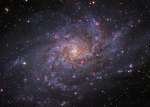 M33: Triangulum Galaxy
20.12.2012
The small, northern constellation Triangulum harbors this magnificent face-on spiral galaxy, M33. Its popular names include the Pinwheel Galaxy or just the Triangulum Galaxy. M33 is over 50,000 light-years in diameter, third largest in the Local Group of galaxies after the Andromeda Galaxy (M31), and our own Milky Way.
 APOD: 2023 October 11 Б NGC 1097: Spiral Galaxy with Supernova
10.10.2023
What's happening in the lower arm of this spiral galaxy? A supernova. Last month, supernova SN 2023rve was discovered with UAE's Al-Khatim Observatory and later found to be consistent with the death explosion of a massive star, possibly leaving behind a black hole.
 APOD: 2024 February 12 Б HFG1 & Abell 6: Planetary Nebulae
11.02.2024
Planetary nebulae like Heckathorn-Fesen-Gull 1 (HFG1) and Abell 6 in the constellation Cassiopeia are remnants from the last phase of a medium sized star like our Sun. In spite of their shapes, planetary nebulae have nothing in common with actual planets.
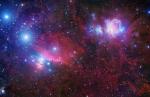 The Orion Deep Field
5.01.2007
Adrift 1,500 light-years away in one of the night sky's most recognizable constellations, the glowing Orion Nebula and the dark Horsehead Nebula are contrasting cosmic vistas. But even fainter filaments of glowing...
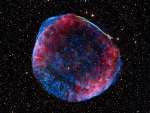 SN 1006 Supernova Remnant
4.07.2008
A new star, likely the brightest supernova in recorded human history, lit up planet Earth's sky in the year 1006 AD. The expanding debris cloud from the stellar explosion, found in the southerly constellation of Lupus, still puts on a cosmic light show across the electromagnetic spectrum.
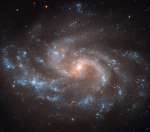 NGC 5584: Expanding the Universe
30.03.2011
Big, beautiful NGC 5548 is more that 50,000 light-years across and lies 72 million light-years away toward the constellation Virgo. The winding spiral arms of this gorgeous island universe are loaded with luminous young star clusters and dark dust lanes. Still, for earthbound astronomers NGC 5548 is not just another pretty face-on spiral galaxy.
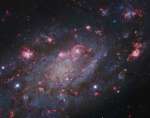 NGC 2403 in Camelopardalis
23.07.2011
Magnificent island universe NGC 2403 stands within the boundaries of the long-necked constellation Camelopardalis. Some 10 million light-years distant and about 50,000 light-years across, the spiral galaxy also seems to have more than its fair share of giant star forming HII regions, marked by the telltale reddish glow of atomic hydrogen gas.
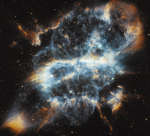 NGC 5189: An Unusually Complex Planetary Nebula
19.12.2012
Why is this nebula so complex? When a star like our Sun is dying, it will cast off its outer layers, usually into a simple overall shape. Sometimes this shape is a sphere, sometimes a double lobe, and sometimes a ring or a helix.
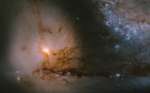 NGC 5195: The Dot under the Question Mark
31.08.2013
Dwarf galaxy NGC 5195 is best known as the smaller companion of spiral M51, the Whirlpool galaxy. Seen together they seem to trace the curve and dot of a cosmic question mark, recorded in Lord Rosse's 19th century drawings as one of the original spiral nebulae.
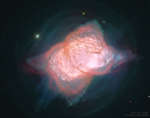 Bright Planetary Nebula NGC 7027 from Hubble
8.01.2018
It is one of the brightest planetary nebulae on the sky -- what should it be named? First discovered in 1878, nebula NGC 7027 can be seen toward the constellation of the Swan (Cygnus) with a standard backyard telescope.
|
January February March April May June July August September October |
|||||||||||||||||||||||||||||||||||||||||||||||||