
|
You entered: constellation
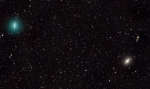 Comet Iwamoto and the Sombrero Galaxy
9.02.2019
Comet Iwamoto (C/2018 Y1), shows off a pretty, greenish coma at the upper left in this telescopic field of view. Taken on February 4 from the Mount John Observatory, University of Canterbury...
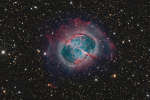 M27: Not a Comet
29.08.2019
While hunting for comets in the skies above 18th century France, astronomer Charles Messier diligently kept a list of the things he encountered that were definitely not comets. This is number 27 on his now famous not-a-comet list.
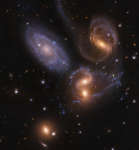 Stephan s Quintet
18.12.2021
The first identified compact galaxy group, Stephan's Quintet is featured in this eye-catching image constructed with data drawn from the extensive Hubble Legacy Archive. About 300 million light-years away, only four of these five galaxies are actually locked in a cosmic dance of repeated close encounters.
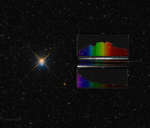 Beautiful Albireo AB
24.02.2022
Beta Cygni is a single bright star to the naked eye. About 420 light-years away it marks the foot of the Northern Cross, famous asterism in the constellation Cygnus. But a view through...
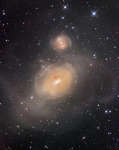 NGC 1316: After Galaxies Collide
2.02.2017
An example of violence on a cosmic scale, enormous elliptical galaxy NGC 1316 lies about 75 million light-years away toward Fornax, the southern constellation of the Furnace. Investigating the startling sight, astronomers suspect the giant galaxy of colliding with smaller neighbor NGC 1317 seen just above, causing far flung loops and shells of stars.
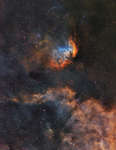 The Tulip and Cygnus X 1
29.07.2021
This tall telescopic field of view looks out along the plane of our Milky Way Galaxy toward the nebula rich constellation Cygnus the Swan. Popularly called the Tulip Nebula, the brightest glowing cloud of interstellar gas and dust above center is also found in the 1959 catalog by astronomer Stewart Sharpless as Sh2-101.
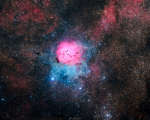 A Beautiful Trifid
5.08.2022
The beautiful Trifid Nebula is a cosmic study in contrasts. Also known as M20, it lies about 5,000 light-years away toward the nebula rich constellation Sagittarius. A star forming region in the plane...
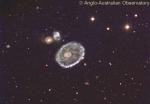 The Cartwheel Galaxy
12.06.2001
By chance, a collision of two galaxies has created a surprisingly recognizable shape on a cosmic scale. The Cartwheel Galaxy is part of a group of galaxies about 500 million light years away in the constellation Sculptor. Two smaller galaxies in the group are visible on the left of the above photograph.
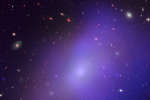 Elliptical Galaxy NGC 1132
13.02.2008
NGC 1132 is one smooth galaxy -- but how did it form? As an elliptical galaxy, NGC 1132 has little dust and gas, and few stars have formed in it recently. Although many elliptical galaxies are in clusters of galaxies, NGC 1132 appears as a large, isolated galaxy toward the constellation of the River (Eridanus).
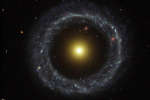 Hoags Object: A Strange Ring Galaxy
22.08.2010
Is this one galaxy or two? This question came to light in 1950 when astronomer Art Hoag chanced upon this unusual extragalactic object. On the outside is a ring dominated by bright blue stars, while near the center lies a ball of much redder stars that are likely much older.
|
January February March April May June July August September October |
|||||||||||||||||||||||||||||||||||||||||||||||||