
|
You entered: constellation
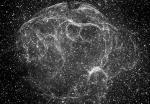 Simeis 147: Supernova Remnant
30.08.2002
It's easy to get lost following the intricate filaments in this stunningly detailed image of faint supernova remnant Simeis 147. Seen towards the constellation Taurus it covers nearly 3 degrees (6 full moons)...
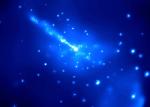 Centaurus A: X-Rays from an Active Galaxy
5.07.2003
Its core hidden from optical view by a thick lane of dust, the giant elliptical galaxy Centaurus A was among the first objects observed by the orbiting Chandra X-ray Observatory. Astronomers were not disappointed, as Centaurus A's appearance in x-rays makes its classification as an active galaxy easy to appreciate.
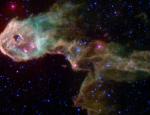 Inside The Elephant s Trunk
19.12.2003
Spectacular first images from the newly christened Spitzer Space Telescope include this penetrating interior view of an otherwise opaque dark globule known as the Elephant's Trunk Nebula. Seen in a composite of infrared...
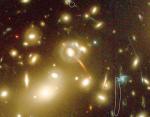 Galaxy Cluster Lenses Farthest Known Galaxy
17.02.2004
Gravity can bend light, allowing whole clusters of galaxies to act as huge telescopes. Almost all of the bright objects in this just-released Hubble Space Telescope image are galaxies in the cluster known as Abell 2218.
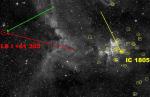 Microquasar in Motion
16.09.2004
Microquasars, bizarre binary star systems, generating high-energy radiation and blasting out jets of particles at nearly the speed of light, live in our Milky Way galaxy. The energetic microquasar systems seem to consist...
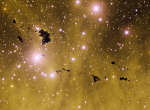 Thackerays Globules
12.06.2012
These are larger dust bunnies than you will find under your bed. Situated in rich star fields and glowing hydrogen gas, these opaque clouds of interstellar dust and gas are so large they might be able to form stars.
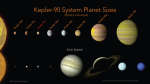 The Kepler 90 Planetary System
18.12.2017
Do other stars have planetary systems like our own? Yes -- one such system is Kepler-90. Cataloged by the orbiting Kepler satellite, an eighth planet has now been discovered giving Kepler-90 the same number of known planets as our Solar System.
 Highlights of the Summer Sky
27.06.2018
What can you see in the night sky this summer? The featured graphic gives a few highlights for Earth's northern hemisphere. Viewed as a clock face centered at the bottom, early (northern) summer sky events fan out toward the left, while late summer events are projected toward the right.
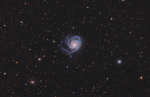 A View Toward M101
15.03.2019
Big, beautiful spiral galaxy M101 is one of the last entries in Charles Messier's famous catalog, but definitely not one of the least. About 170,000 light-years across, this galaxy is enormous, almost twice the size of our own Milky Way galaxy.
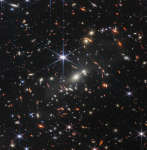 Webb s First Deep Field
13.07.2022
This is the deepest, sharpest infrared image of the cosmos so far. The view of the early Universe toward the southern constellation Volans was achieved in 12.5 hours of exposure with the NIRCam instrument on the James Webb Space Telescope. Of course the stars with six visible spikes are well within our own Milky Way.
|
January February March April May June July August September October |
|||||||||||||||||||||||||||||||||||||||||||||||||