
|
You entered: astronomer
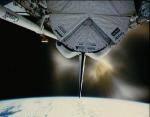 Shuttle Engine Blast
26.01.2002
The Space Shuttle Discovery's orbital maneuvering system (OMS) engine firing produced this dramatic flare as it cruised "upside down" in low Earth orbit. Discovery was named for a ship commanded by Captain James Cook RN, the 18th Century English astronomer and navigator.
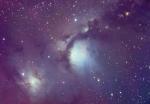 The Reflecting Dust Clouds of Orion
21.01.2003
In the vast Orion Molecular Cloud complex, several bright blue nebula are particularly apparent. Pictured above are two of the most prominent reflection nebulas -- dust clouds lit by the reflecting light of bright-embedded stars. The more famous nebula is M78, on the upper right, cataloged over 200 years ago.
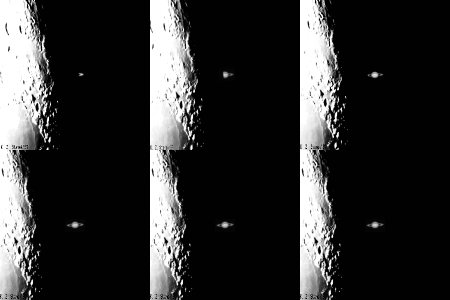 Moon Occults Saturn
24.09.1997
Many stargazers in the U. S. were able to watch a lovely lunar occultation early last Thursday morning as a bright Moon passed in front of Saturn. Using a 1.2 meter reflector, astronomer Kris Stanek had an excellent view of this dream-like event from the Whipple Observatory atop Arizona's Mount Hopkins.
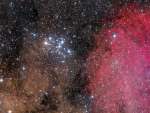 M6: The Butterfly Cluster
3.09.2014
To some, the outline of the open cluster of stars M6 resembles a butterfly. M6, also known as NGC 6405, spans about 20 light-years and lies about 2,000 light years distant. M6, pictured...
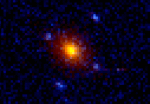 A Galaxy Gravitational Lens
20.12.1995
Sometimes it takes a keen eye to see a good mirage. Around the center of the red galaxy image in the above photograph lie four blue "smudges." Each smudge is actually a different image of the same background quasar. The central galaxy happens to fall directly in the light path of the quasar.
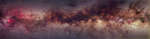 A Milky Way Band
10.07.2011
Most bright stars in our Milky Way Galaxy reside in a disk. Since our Sun also resides in this disk, these stars appear to us as a diffuse band that circles the sky.
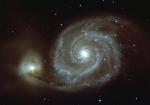 M51: The Whirlpool Galaxy
24.07.2000
The Whirlpool Galaxy is a classic spiral galaxy. At only 23 million light years distant and fully 65 thousand light years across, M51, also known as NGC 5194, is one of the brightest and most picturesque galaxies on the sky.
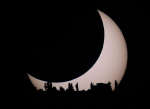 Contemplating the Sun
28.05.2012
Have you contemplated your home star recently? Pictured above, a Sun partially eclipsed on the top left by the Moon is also seen eclipsed by earthlings contemplating the eclipse below. The above menagerie...
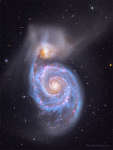 APOD: 2026 January 14 Б M51: The Whirlpool Galaxy
14.01.2026
The Whirlpool Galaxy is a classic spiral galaxy. At only 30 million light years distant and fully 60 thousand light years across, M51, also known as NGC 5194, is one of the brightest and most picturesque galaxies on the sky.
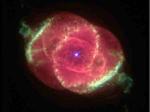 The Cats Eye Nebula
24.03.2002
Three thousand light-years away, a dying star throws off shells of glowing gas. This image from the Hubble Space Telescope reveals the Cat's Eye Nebula to be one of the most complex planetary nebulae known.
|
January February March April May June July August |
||||||||||||||||||||||||||||||||||||||||||||||||||||||||