
|
You entered: astronomer
 M51: The Whirlpool Galaxy from Hubble
13.06.2022
The Whirlpool Galaxy is a classic spiral galaxy. At only 30 million light years distant and fully 60 thousand light years across, M51, also known as NGC 5194, is one of the brightest and most picturesque galaxies on the sky.
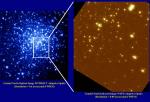 NGC 6934 from Gemini North
30.06.1999
What's going on near the center of globular cluster NGC 6934? The blur caused by the Earth's atmosphere has prevented astronomers from discerning individual stars in this unusual environment. Telescopes in space can help, but the new Gemini North telescope took the above picture from the ground.
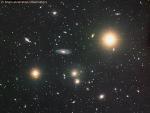 The Hydra Cluster of Galaxies
16.04.2001
The Hydra Cluster of Galaxies contains well over 100 bright galaxies - but perhaps fewer galaxies than might be expected from its mass. Clusters of galaxies are the largest gravitationally bound objects in the universe.
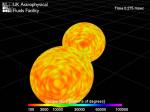 On the Origin of Gold
5.04.2001
Where did the gold in your jewelry originate? No one is completely sure. The relative average abundance in our Solar System appears higher than can be made in the early universe, in stars, and even in typical supernova explosions. Some astronomers now
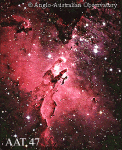 M16: Dust and an Open Cluster
1.11.1995
The photogenic M16 shown above is composed of a young star cluster and a spectacular emission nebulae lined with distinct regions of interstellar dust. Most of the stars in the cluster can be seen offset just above and to the right of the photograph's center.
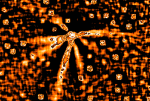 Seven Jets from Comet Hale-Bopp
13.11.1996
Comet Hale-Bopp is turning out to be quite unusual. One reason is the great amount of jet activity at such a large distance from the Sun. In the above false-color image, no less than seven jets can be seen emanating from Hale-Bopp's coma.
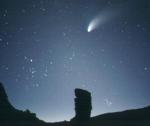 Help Aldebaran Map the Moon
28.07.1997
Turn on your camcorder, go outside, and become an astronomer. How?. Tomorrow morning, our Moon will pass directly in front of Aldebaran, the brightest star in this picture and in entire constellation of Taurus.
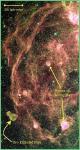 Stellar Laboratories in the LMC
25.07.1997
Stars are evolving in the Large Magellanic Clouds (LMC). This is particularly evident in the above close-up of the LMC's edge, which appears about as large as the full moon. Visible only...
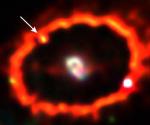 Shocked by Supernova 1987a
17.02.1998
Eleven years ago the brightest supernova of modern times was recorded. Now the expanding debris from this tremendous stellar explosion is seen to be crashing into previously expelled material. The onset of this collision is shown by the arrow in the above picture as the yellow spot on the interior of the ring.
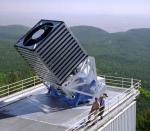 The Sloan Digital Sky Survey Telescope
17.06.1998
The Sloan Digital Sky Survey (SDSS) will soon begin. Pictured above is the 2.5-meter telescope poised to create the most ambitious sky map in the history of astronomy. SDSS will catalog one quarter of the sky down past 23rd magnitude ( R), obtaining redshifts for galaxies and quasars brighter than magnitude 19.
|
January February March April May June July August |
||||||||||||||||||||||||||||||||||||||||||||||||||||||||