
|
You entered: astronomer
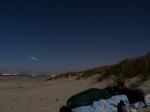 Ceci n est pas un Meteore
19.08.2006
To paraphrase Magritte, "This is not a meteor". It's not a picture of a meteor either, but it was taken during last weekend's peak of the Perseid Meteor shower. Skywatching with friends...
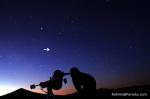 Nova Over Iran
19.02.2007
A bright new nova is being studied by astronomers. The officially dubbed Nova Scorpii 2007 has become so bright in recent days that it is now visible to the unaided eye. Adventurous early morning sky enthusiasts should look in dark skies toward the constellation of the Scorpion, just below Jupiter and Antares.
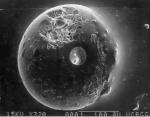 A Spherule from Outer Space
12.01.2003
When a meteorite strikes the Moon, the energy of the impact melts some of the splattering rock, a fraction of which might cool into tiny glass beads. Many of these glass beads were present in lunar soil samples returned to Earth by the Apollo missions.
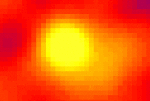 GRB970228: What's There?
7.04.1997
Could this fuzzy blob be the key to the whole gamma-ray burst (GRB) mystery? Astronomers the world over are now scrambling to determine the true nature of the extended emission seen to the lower right of the bright source in the above image.
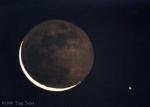 Mercury And The Moon
11.11.1999
Mercury is the closest planet to the Sun and never moves far from our parent star in Earth's sky. Racing around its tight orbit, this well-done world is a little over 1/3 the diameter of Earth and is often lost to our view in the solar glare.
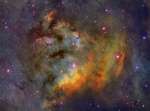 Sharpless 171
18.10.2008
Cosmic pillars of cold molecular gas and clouds of dark dust lie within Sharpless 171, a star-forming region some 3,000 light-years away in the royal constellation Cepheus. This tantalizing false-color skyscape spans about 20 light-years across the nebula's bright central region.
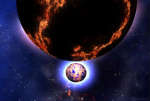 On the Origin of Gold
15.10.2017
Where did the gold in your jewelry originate? No one is completely sure. The relative average abundance in our Solar System appears higher than can be made in the early universe, in stars, and even in typical supernova explosions.
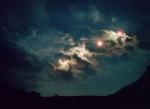 Many Moons
5.07.2002
Whimsical and creative, this multiple exposure suggests that planet Earth's sky could be very dramatic indeed if it were graced by many moons. And in James Thurber's well-known children's story, Princess...
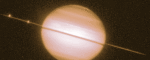 Crossing The Ring Plane
1.08.1995
"I do not know what to say in a case so surprising, so unlooked for and so novel." announced Galileo when Saturn's rings appeared to vanish in 1612. In fact, every 15 years Saturn's rings seem to almost disappear as viewed from the Earth.
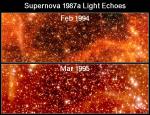 Moving Echoes Around SN 1987A
24.10.1997
Yesterday's image highlighted reflective rings of light emitted by a supernova explosion. Today's pictures, taken over a year apart, highlight how these echoes are seen to move over time. Visible...
|
January February March April May June July August |
||||||||||||||||||||||||||||||||||||||||||||||||||||||||