
|
You entered: astronomer
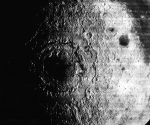 Mare Orientale
12.01.1996
Looking like a target ring bull's-eye, the Mare Orientale is one of the most striking large scale lunar features. Located on the Moon's extreme western edge, this impact basin is unfortunately difficult to see from an earthbound perspective.
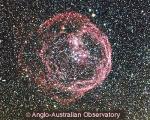 Henize 70: A SuperBubble In The LMC
13.06.1998
Stars with tens of times the mass of the Sun profoundly affect their galactic environment. Churning and mixing the interstellar gas and dust clouds they leave their mark in the compositions and locations of future generations of stars and star systems.
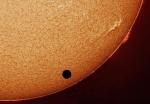 Venus and the Chromosphere
11.06.2004
Enjoying the 2004 Transit of Venus from Stuttgart, Germany, astronomer Stefan Seip recorded this fascinating, detailed image of the Sun. Revealing a network of cells and dark filaments against a bright solar disk with spicules and prominences along the Sun's limb, his telescopic picture was taken through an H-alpha filter.
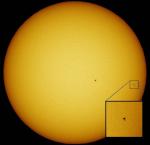 ISS and Discovery Transit the Sun
29.07.2005
That large sunspot near the right edge of the Sun is actually not a sunspot at all. It's the International Space Station (ISS) docked with the Space Shuttle Discovery on mission STS-114.
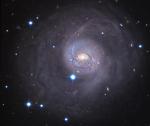 The Outskirts of M77
7.12.2006
Face-on spiral galaxy M77 lies a mere 60 million light-years away toward the constellation Cetus. Also known as NGC 1068, it's very bright core is well studied by astronomers exploring the mysteries of supermassive black holes in active galaxies.
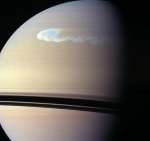 Saturn Storm
19.01.2011
Late last year, a new, remarkably bright storm erupted in Saturn's northern hemisphere. Amateur astronomers first spotted it in early December, with the ringed gas giant rising in planet Earth's predawn sky.
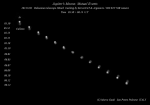 Io and Callisto Mutual Event
25.11.2014
A 24 minute sequence from top to bottom, this intriguing series of telescopic frames tracks the occultation of Io by Callisto, two of Jupiter's Galilean moons, from San Pietro Polesine, Italy, planet Earth. A challenging observational project using a small telescope, the two contrasting Jovian worlds are both slightly larger than Earth's Moon.
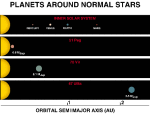 Planets Around Sun-Like Stars
31.01.1996
Do many Sun-like stars have planets? Speculation on this point has been ongoing since humanity's realization that other stars existed. Only in the past year, however, have answers and discoveries been realized. The above plot summarizes the four known cases of normal stars having planets.
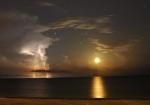 Moon Lightning
7.10.2004
Moonsets are not often quite as exciting as this one. But amateur astronomer Marc-Andre Besel was impressed by the brilliant lighting displays that joined the first quarter Moon and stars of the constellation Scorpius in western skies.
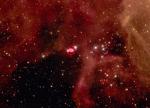 A Supernova Starfield
9.02.1999
Bright stars don't last forever. A bright star similar to others in this field exploded in a spectacular supernova that was witnessed on Earth in 1987. The result is visible even today as unusual rings and glowing gas. The above picture is a composite of recent images taken over several years.
|
January February March April May June July August |
||||||||||||||||||||||||||||||||||||||||||||||||||||||||