
|
You entered: astronomer
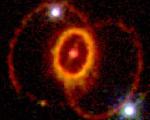 The Mysterious Rings of Supernova 1987A
6.02.2000
What's causing those odd rings in supernova 1987A? In 1987, the brightest supernova in recent history occurred in the Large Magellanic Clouds. At the center of the picture is an object central to the remains of the violent stellar explosion.
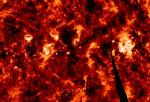 The Frothy Milky Way
9.10.1999
Astronomers have discovered that looking at dust along the plane of our Milky Way Galaxy is a bit like looking into a frothy glass of beer. The dust between stars in our galaxy appears...
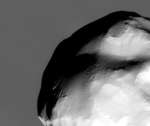 Saturns Moon Helene from Cassini
10.03.2010
What's happening on the surface of Saturn's moon Helene? The moon was imaged in unprecedented detail last week as the robotic Cassini spacecraft orbiting Saturn swooped to within two Earth diameters of the diminutive moon.
 Messier 2
4.04.2019
After the Crab Nebula, M1, this giant star cluster is the second entry in 18th century astronomer Charles Messier's famous list of things with are not comets. M2 is one of the largest globular star clusters now known to roam the halo of our Milky Way galaxy.
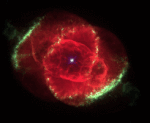 The Cat's Eye Nebula
28.06.1995
Three thousand light years away, a dying star throws off shells of glowing gas. This Hubble Space Telescope image reveals "The Cat's Eye Nebula" to be one of the most complex "planetary nebulae" known.
 VLT: A New Largest Optical Telescope
1.09.1996
What is the largest telescope in the world? In the optical, this title was long held by the Hale 200-inch, and is presently held by the Keck telescopes in Hawaii. But an even larger optical telescope is being built.
 The Frothy Milky Way
24.04.1997
Astronomers have recently discovered that looking at dust along the plane of our Milky Way Galaxy is a bit like looking into a frothy glass of beer. The dust between stars in our galaxy...
 Cold Wind From The Boomerang Nebula
15.10.1997
A cold wind blows from the central star of the Boomerang Nebula. Seen here in a false color image of dust reflected starlight, the nebula lies about 5,000 light-years away. The boomerang shaped...
 A Lunar Eclipse Mosaic
6.05.2004
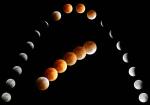
From start to finish, this impressive digital mosaic covers May 4th's total eclipse of the Moon. Astronomer Anthony Ayiomamitis reports that the eclipse viewing was wonderful from Greece, where skies cleared shortly before the celestial show began.
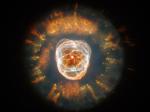 The Eskimo Nebula from Hubble
9.07.2006
In 1787, astronomer William Herschel discovered the Eskimo Nebula. From the ground, NGC 2392 resembles a person's head surrounded by a parka hood. In 2000, the Hubble Space Telescope imaged the Eskimo Nebula. From space, the nebula displays gas clouds so complex they are not fully understood.
|
January February March April May June July August |
||||||||||||||||||||||||||||||||||||||||||||||||||||||||