
|
You entered: astronomer
 NGC 1365: Majestic Island Universe
27.12.2018
Barred spiral galaxy NGC 1365 is truly a majestic island universe some 200,000 light-years across. Located a mere 60 million light-years away toward the chemical constellation Fornax, NGC 1365 is a dominant member of the well-studied Fornax galaxy cluster.
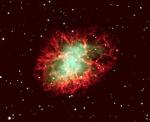 M1: Filaments of the Crab Nebula
6.02.1997
The Crab Nebula is filled with mysterious filaments. The Crab Nebula is the result of a star that exploded in 1054 AD. This spectacular supernova explosion was recorded by Chinese and (quite probably) Anasazi Indian astronomers.
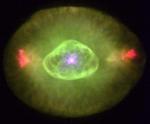 NGC 6826: The Blinking Eye
18.12.1997
The colorful planetary nebula phase of a sun-like star's life is brief. Almost in the "blink of an eye" - cosmically speaking - the star's outer layers are cast off, forming an expanding emission nebula. This nebula lasts perhaps 10 thousand years compared to a 10 billion year stellar life span.
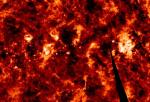 The Frothy Milky Way
2.05.1998
Astronomers have discovered that looking at dust along the plane of our Milky Way Galaxy is a bit like looking into a frothy glass of beer. The dust between stars in our galaxy appears...
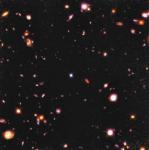 The Hubble Deep Field in Infrared
12.10.1998
Galaxies this faint have never been seen before. In 1996 the Hubble Space Telescope (HST) created one of the most famous pictures of modern astronomy, the Hubble Deep Field (HDF). Now HST has returned to a piece of the HDF for a long exposure by its new NICMOS camera, sensitive to infrared light.
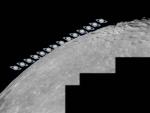 Eclipsing the Rings
15.03.2007
The March 3rd total lunar eclipse was widely viewed by denizens of planet Earth. But only a day before, well placed observers could also watch a lunar occultation of Saturn as the planet passed behind the nearly Full Moon.
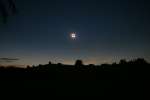 Eclipse over the Great Wall
31.08.2008
Contrary to the famous myth, you can't see the Great Wall of China from the Moon ... even during a total solar eclipse. But on August 1 you could see the Moon eclipsing the Sun from the Great Wall.
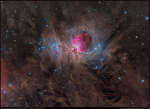 The Great Orion Nebula M42
3.11.2015
The Great Nebula in Orion, also known as M42, is one of the most famous nebulas in the sky. The star forming region's glowing gas clouds and hot young stars are on the right in this sharp and colorful image that includes the bluish reflection nebulae NGC 1977 and friends on the left.
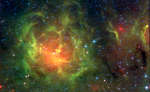 Infrared Trifid
24.07.2015
The Trifid Nebula, also known as Messier 20, is easy to find with a small telescope, a well known stop in the nebula rich constellation Sagittarius. But where visible light pictures show the nebula...
 Wolf Lundmark Melotte
18.05.2017
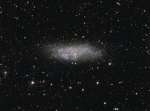
Named for the three astronomers instrumental in its discovery and identification, Wolf - Lundmark - Melotte (WLM) is a lonely dwarf galaxy. Seen toward the mostly southern constellation Cetus, about 3 million light-years from the Milky Way, it is one of the most remote members of our local galaxy group.
|
January February March April May June July August |
||||||||||||||||||||||||||||||||||||||||||||||||||||||||