
|
You entered: astronomer
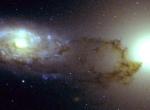 Dusting Spiral Galaxies
16.01.1998
How much dust is in spiral galaxies? Does it block out much of the starlight? Because astronomers rely on an accurate knowledge of galaxy properties to investigate a wide range of problems, like galaxy and quasar evolution and the nature of dark matter, answers to simple questions like this are key.
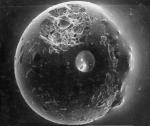 A Spherule from the Earths Moon
15.02.2004
How did this spherule come to be on the Moon? When a meteorite strikes the Moon, the energy of the impact melts some of the splattering rock, a fraction of which might cool into tiny glass beads. Many of these glass beads were present in lunar soil samples returned to Earth by the Apollo missions.
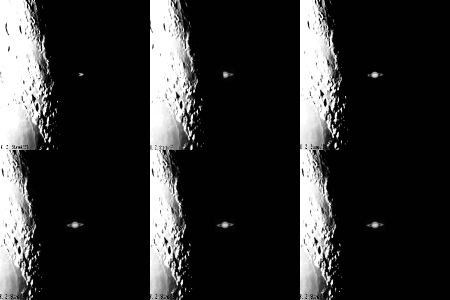 Moon Occults Saturn
8.05.1999
On September 18, 1997, many stargazers in the U. S. were able to watch a lovely early morning lunar occultation as a bright Moon passed in front of Saturn. Using a 1.2 meter reflector, astronomer Kris Stanek had an excellent view of this dream-like event from the Whipple Observatory atop Arizona's Mount Hopkins.
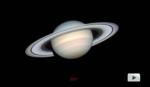 Four Years of Saturn
6.04.2007
Saturn and its magnificent ring system can offer even casual astronomers the most memorable of telescopic sights. Wandering between Leo and Cancer this month, a bright Saturn is well placed for viewing in evening skies. But from our earthbound perspective, the tilt of Saturn's rings does change with time.
 Aurora Persei
9.08.2008
Dark skies are favored for viewing meteor showers -- so the best viewing of this year's Perseids will occur in the early morning. While the Perseid meteor shower is scheduled to peak over...
 Announcing Nova Carinae 2018
25.03.2018
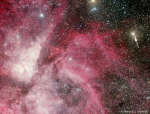
How bright will Nova Carinae 2018 become? The new nova was discovered only last week. Although novas occur frequently throughout the universe, this nova, cataloged as ASASSN-18fv, is so unusually bright in the skies of Earth that it is now easily visible through binoculars in the southern hemisphere.
 Spiral Galaxy NGC 1350
12.02.2021
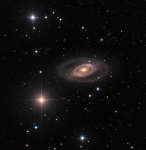
This gorgeous island universe lies about 85 million light-years distant in the southern constellation Fornax. Inhabited by young blue star clusters, the tightly wound spiral arms of NGC 1350 seem to join in a circle around the galaxy's large, bright nucleus, giving it the appearance of a cosmic eye.
 A Lonely Neutron Star
28.11.1998
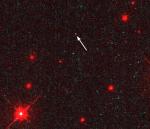
How massive can a star get without imploding into a black hole? These limits are being tested by the discovery of a lone neutron star in space. Observations by the Hubble Space Telescope have...
 Pumpkin Moon
30.10.2004
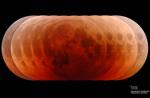
Does this look familiar? Red and orange hues haunting the face of the Moon might remind you of the October 27th total lunar eclipse, but the picture is actually a montage of images from a similar lunar spectacle in May of 2003.
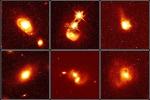 A Quasar Portrait Gallery
6.12.1997
QUASARs (QUASi-stellAR objects) lie near the edge of the observable Universe. Discovered in 1963, astronomers were astounded that such objects could be visible across billions of light-years, as this implies they must emit prodigious amounts of energy. Where does the energy come from?
|
January February March April May June July August |
||||||||||||||||||||||||||||||||||||||||||||||||||||||||