
|
You entered: astronomer
 Clearing Skies
26.07.2002
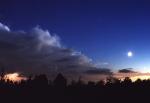
Clear evening skies are a welcome sight for stargazers worldwide, but clearing skies are good too. Just such a glorious occasion was recorded in this dramatic photo taken by Dominic Cantin during a recent gathering of Canadian astronomers at St-NИrИe Observatory, located about 60 kilometers southeast of the city of Quebec.
 A Wind From The Sun
17.02.1997
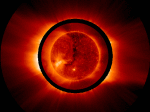
A wind from the Sun blows through our Solar System. The behaviour of comet tails as they flapped and waved in this interplanetary breeze gave astronomers the first hint of its existence. Streaming outward...
 Gamma Ray Quasar
26.12.1998
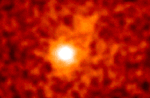
The bright object in the center of the false color image above is quasar 3C279 viewed in gamma-rays, photons with more than 40 million times the energy of visible light. Like all quasars, 3C279 is a nondescript, faint, star-like object in the visible sky.
 Brown Sun Bubbling
10.01.2000
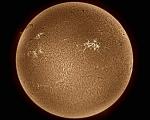
Our Sun may look like all soft and fluffy, but its not. Our Sun is an extremely large ball of bubbling hot gas, mostly hydrogen gas. The above picture was taken in a specific color of light emitted by hydrogen gas called Hydrogen-alpha.
 The Cats Eye Nebula
26.08.2012
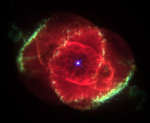
Three thousand light-years away, a dying star throws off shells of glowing gas. This image from the Hubble Space Telescope reveals the Cat's Eye Nebula to be one of the most complex planetary nebulae known.
 Wolf-Lundmark-Melotte
7.04.2016
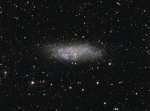
Named for the three astronomers instrumental in its discovery and identification, Wolf - Lundmark - Melotte (WLM) is a lonely dwarf galaxy. Seen toward the mostly southern constellation Cetus, about 3 million light-years from the Milky Way, it is one of the most remote members of our local galaxy group.
 The Cats Eye Nebula
3.07.2016
Three thousand light-years away, a dying star throws off shells of glowing gas. This image from the Hubble Space Telescope reveals the Cat's Eye Nebula to be one of the most complex planetary nebulae known.
 Under the Galaxy
13.10.2017
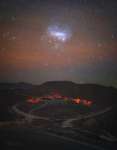
The Large Magellanic Cloud, a satellite galaxy of the Milky Way, stands above the southern horizon in this telephoto view from Las Campanas Observatory, planet Earth. In the dark September skies of the Chilean Atacama desert, the small galaxy has an impressive span of about 10 degrees or 20 Full Moons.
 The Einstein Cross Gravitational Lens
10.10.2000
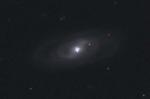
Most galaxies have a single nucleus -- does this galaxy have four? The strange answer leads astronomers to conclude that the nucleus of the surrounding galaxy is not even visible in this image. The central cloverleaf is rather light emitted from a background quasar.
 Comet Hale-Bopp Update
30.10.1995
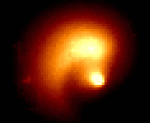
Will comet Hale-Bopp become the brightest comet of the Century in early 1997? Since its discovery in July this year, Hale-Bopp has caused much speculation. Even though it is still beyond the orbit of Jupiter it is astonishingly bright and expected to get much brighter as it plunges inward, toward the Sun.
|
January February March April May June July August |
||||||||||||||||||||||||||||||||||||||||||||||||||||||||