
|
You entered: astronomer
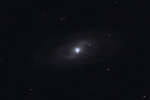 The Einstein Cross Gravitational Lens
7.02.2010
Most galaxies have a single nucleus -- does this galaxy have four? The strange answer leads astronomers to conclude that the nucleus of the surrounding galaxy is not even visible in this image. The central cloverleaf is rather light emitted from a background quasar.
 APOD: 2025 July 31 Б Supernova 2025rbs in NGC 7331
31.07.2025
A long time ago in a galaxy 50 million light-years away, a star exploded. Light from that supernova was first detected by telescopes on planet Earth on July 14th though, and the extragalactic transient is now known to astronomers as supernova 2025rbs.
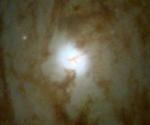 M51: The Center Of The Whirlpool
27.05.2000
In the center of M51, a spiral galaxy 23 million light-years away, astronomers have identified a dense region of young stars. Viewed face-on in the constellation Canes Venatici, the swirling arcs of this galaxy's spiral arms have inspired its popular name, The Whirlpool Galaxy.
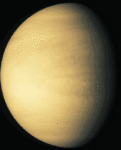 Venus: Earth's Sister Planet
15.08.1995
This picture in visible light was taken by the Galileo spacecraft. Venus is very similar to Earth in size and mass - and so is sometimes referred to as Earth's sister planet - but Venus has a quite different climate.
 Painting with Solar Neutrons
25.10.1995
Solar flares are propelled high above the Sun's surface by powerful, twisted magnetic fields. The flares spew high energy atomic and subatomic particles into space. During an intense solar flare on June 15, 1991, a spray of solar neutrons was detected by the COMPTEL instrument onboard NASA's Compton Gamma Ray Observatory.
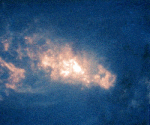 In the Center of Spiral M77
11.09.1996
What is happening in the center of nearby spiral galaxy M77? To find out, astronomers used the Hubble Space Telescope to peer deep into the dusty chaos of this active galactic nucleus in 1994.
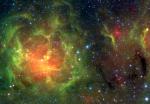 Infrared Trifid
13.01.2005
The Trifid Nebula, aka M20, is easy to find with a small telescope, a well known stop in the nebula rich constellation Sagittarius. But where visible light pictures show the nebula divided into three parts by dark, obscuring dust lanes, this penetrating infrared image reveals filaments of luminous gas and newborn stars.
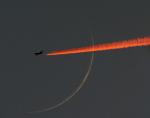 When the Moon Was Young
13.05.2005
Remember when the Moon was young? It was just last Monday. On May 9th, this slender crescent Moon was recorded at a tender age of 34 hours and 18 minutes. Well, OK ... when calculating...
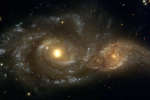 Spiral Galaxies in Collision
20.04.2008
Billions of years from now, only one of these two galaxies will remain. Until then, spiral galaxies NGC 2207 and IC 2163 will slowly pull each other apart, creating tides of matter, sheets of shocked gas, lanes of dark dust, bursts of star formation, and streams of cast-away stars.
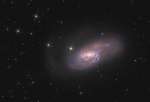 Spiral Galaxy M66
13.11.2010
Big beautiful spiral galaxy M66 lies a mere 35 million light-years away. About 100 thousand light-years across, the gorgeous island universe is well known to astronomers as a member of the Leo Triplet of galaxies.
|
January February March April May June July August |
||||||||||||||||||||||||||||||||||||||||||||||||||||||||