
|
You entered: astronomer
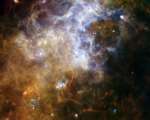 Herschel Views the Milky Way
2.09.2011
With a 3.5 meter diameter mirror, larger than the Hubble Space Telescope, ESA's Herschel Space Observatory explores the Universe at infrared wavelengths. Herschel is named for German-born British astronomer Frederick William Herschel who discovered infrared light over 200 years ago.
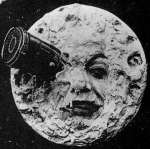 A Trip to the Moon
13.01.2014
What would it be like to visit the Moon? The first major fictional cinematic film exploring this enduring transcultural fantasy was titled Le voyage dans la lune (A Trip to the Moon) and made in 1902, becoming one of the most popular movies of the early years of the twentieth century.
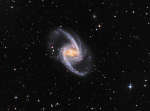 NGC 1365: Majestic Island Universe
11.10.2017
Barred spiral galaxy NGC 1365 is truly a majestic island universe some 200,000 light-years across. Located a mere 60 million light-years away toward the chemical constellation Fornax, NGC 1365 is a dominant member of the well-studied Fornax galaxy cluster.
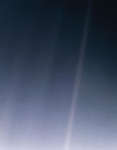 The Pale Blue Dot
13.02.2020
On Valentine's Day in 1990, cruising four billion miles from the Sun, the Voyager 1 spacecraft looked back one last time to make the first ever Solar System family portrait. The portrait consists...
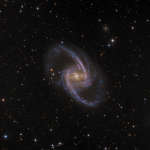 NGC 1365: Majestic Island Universe
7.01.2021
Barred spiral galaxy NGC 1365 is truly a majestic island universe some 200,000 light-years across. Located a mere 60 million light-years away toward the chemical constellation Fornax, NGC 1365 is a dominant member of the well-studied Fornax Cluster of galaxies.
 APOD: 2024 March 13 Б The Seagull Nebula
12.03.2024
A broad expanse of glowing gas and dust presents a bird-like visage to astronomers from planet Earth, suggesting its popular moniker: the Seagull Nebula. This portrait of the cosmic bird covers a 1.6-degree...
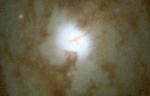 In the Center of the Whirlpool
25.04.1996
In the center of M51, a spiral galaxy 23 million light-years away, astronomers have identified a dense region of young stars. The graceful swirling arcs of this galaxy's spiral arms have inspired its popular name, "The Whirlpool Galaxy".
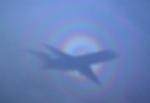 The Giant and the Glory
6.08.2004
On a flight from Vienna to Brussels, astronomer Franz Kerschbaum looked out the window and photographed this beautiful atmospheric phenomenon, the glory, shining in the direction directly opposite the Sun. Before airplanes, the glory, known to some as the heiligenschein or the Specter of the Brocken, was occasionally seen from mountaintops.
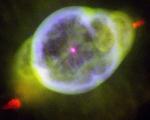 NGC 3242: The Ghost of Jupiter
29.10.2005
After a star like the Sun completes fusion in its core, it throws off its outer layers in a brief, beautiful cosmic display called a planetary nebula. NGC 3242 is such a planetary nebula, with the stellar remnant white dwarf star visible at the center.
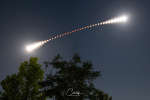 A Digital Lunar Eclipse
18.05.2022
Recorded on May 15/16 this sequence of exposures follows the Full Moon during a total lunar eclipse as it arcs above treetops in the clearing skies of central Florida. A frame taken every 5 minutes by a digital camera shows the progression of the eclipse over three hours.
|
January February March April May June July August |
||||||||||||||||||||||||||||||||||||||||||||||||||||||||