
|
You entered: image
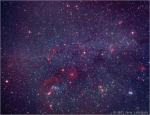 The Winter Hexagon
6.11.2002
Some of the brightest stars form a large and easily found pattern in the winter sky of Earth's northern hemisphere. Dubbed the Winter Hexagon, the stars involved can usually be identified even in the bright night skies of a big city.
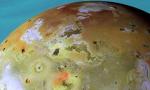 Sizzling Io
6.07.1998
What's cooking on Io? This active moon of Jupiter is marked with volcanoes spewing lava that is now known to be hotter than any lava on Earth. Above is the highest resolution color-enhanced image yet composed of the most active surface in our Solar System. Features as small as three kilometers are visible.
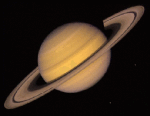 Saturn, Rings, and Two Moons
6.07.1995
This image of Saturn was made by NASA's robot spacecraft Voyager 2 as it began to explore the Saturn system in 1981. Saturn's famous rings are visible along with two of its moons, Rhea and Dione which appear as faint dots in the right and lower right part of the picture.
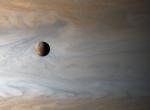 Io: Moon Over Jupiter
6.07.2002
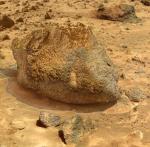 Yogi Rock on Mars
9.03.1998
Yogi is possibly the best photographed rock on Mars. By combining many pictures taken during the Mars Pathfinder Mission last year, scientists were able to create a super-resolution, digitally enhanced image that better allows them to study Yogi's surface and more accurately determine how Yogi was formed.
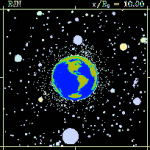 Neutron Star Earth
16.06.1995
If the Earth could somehow be transformed to the ultra-high density of a neutron star , it might appear as it does in the above computer generated figure. Due to the very strong gravitational field, the neutron star distorts light from the background sky greatly. If you look closely, two
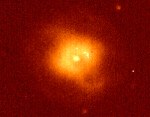 NGC 4361: Galaxy Shaped Planetary Nebula
29.12.1995
Glowing in the red light emitted by hydrogen atoms, the planetary nebula NGC 4361 is pictured above. The nebula itself is formed by the outer layers of gas shrugged off by the central star visible in the image.
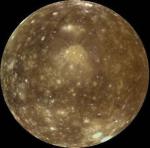 Callisto in True Color
11.05.1998
Callisto's surface has many stories to tell. The most distant of Jupiter's Galilean Moons, Callisto shows the highest density of impact craters in the Solar System, but harbors no volcanoes or even any large mountains. Callisto's surface is laced with cracks and craters from
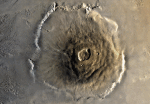 The Mountains of Mars
19.07.1995
Volcanic activity on Mars has produced towering mountains. The largest one, Olympus Mons, is pictured here in this Viking Orbiter image. Olympus Mons is a shield volcano nearly 15 miles high and over 300 miles wide at its base.
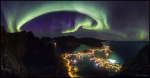 Northern Lights above Lofoten
16.06.2016
The Aurora Borealis or northern lights are familiar visitors to night skies above the village of Reine in the Lofoten Islands, Norway, planet Earth. In this scene, captured from a mountaintop camp site, the auroral curtains do seem to create an eerie tension with the coastal lights though.
|
January February March April May June July August September |
|||||||||||||||||||||||||||||||||||||||||||||||||