
|
You entered: dust
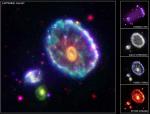 Cartwheel Of Fortune
18.01.2006
By chance, a collision of two galaxies has created a surprisingly recognizable shape on a cosmic scale - The Cartwheel Galaxy. The Cartwheel is part of a group of galaxies about 400 million light years away in the constellation Sculptor (two smaller galaxies in the group are visible below and left).
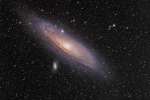 Andromeda Island Universe
9.01.2010
The most distant object easily visible to the eye is M31, the great Andromeda Galaxy some two and a half million light-years away. But without a telescope, even this immense spiral galaxy - spanning over 200,000 light years - appears as a faint, nebulous cloud in the constellation Andromeda.
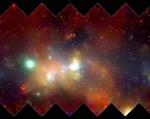 X Ray Milky Way
12.07.2003
If you had x-ray vision, the center regions of our Galaxy would not be hidden from view by the immense cosmic dust clouds opaque to visible light. Instead, the Milky Way toward Sagittarius might look something like this stunning mosaic of images from the orbiting Chandra Observatory.
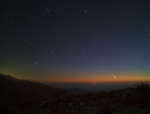 Comets Lemmon and PanSTARRS Peaking
5.03.2013
Two impressive comets will both reach their peak brightness during the next two weeks. Taking advantage of a rare imaging opportunity, both of these comets were captured in the sky together last week over the Atacama desert in South America.
 South of Orion
27.01.2022
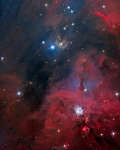
South of the large star-forming region known as the Orion Nebula, lies bright blue reflection nebula NGC 1999. At the edge of the Orion molecular cloud complex some 1,500 light-years distant, NGC 1999's illumination is provided by the embedded variable star V380 Orionis.
 Star Streams and the Sunflower Galaxy
11.09.2010
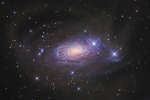
A bright spiral galaxy of the northern sky, Messier 63 is about 25 million light-years distant in the loyal constellation Canes Venatici. Also cataloged as NGC 5055, the majestic island universe is nearly 100,000 light-years across, about the size of our own Milky Way.
 Wonder and Mystery above the Very Large Telescopes
9.05.2011
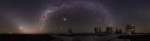
What's that bright orange dot above the large telescope on the right? Even seasoned sky enthusiasts might ponder the origin of the orange orb seen by scrolling across this panoramic image, taken last December. Perhaps identifying known objects will help.
 Spiral Galaxy NGC 4038 in Collision
12.08.2012
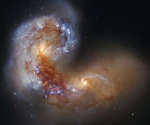
This galaxy is having a bad millennium. In fact, the past 100 million years haven't been so good, and probably the next billion or so will be quite tumultuous. Visible on the upper...
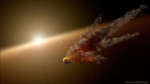 Unexplained Dimmings in KIC 8462852
13.06.2016
Why does star KIC 8462852 keep wavering? Nobody knows. A star somewhat similar to our Sun, KIC 8462852 was one of many distant stars being monitored by NASA's robotic Kepler satellite to see if it had planets.
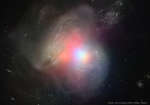 Arp 299: Black Holes in Colliding Galaxies
1.11.2016
Is only one black hole spewing high energy radiation -- or two? To help find out, astronomers trained NASA's Earth-orbiting NuSTAR and Chandra telescopes on Arp 299, the enigmatic colliding galaxies expelling the radiation.
|
January February March April May June July August September October |
|||||||||||||||||||||||||||||||||||||||||||||||||