
|
You entered: dust
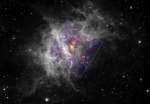 Young Star Cluster Westerlund 2
26.06.2010
Dusty stellar nursery RCW 49 surrounds young star cluster Westerlund 2 in this remarkable composite skyscape from beyond the visible spectrum of light. Infrared data from the Spitzer Space Telescope is shown in black...
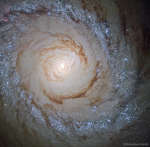 Starburst Galaxy M94 from Hubble
1.12.2019
Why does this galaxy have a ring of bright blue stars? Beautiful island universe Messier 94 lies a mere 15 million light-years distant in the northern constellation of the Hunting Dogs (Canes Venatici).
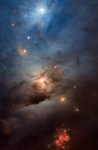 NGC 1333: Stellar Nursery in Perseus
22.04.2023
In visible light NGC 1333 is seen as a reflection nebula, dominated by bluish hues characteristic of starlight reflected by interstellar dust. A mere 1,000 light-years distant toward the heroic constellation Perseus, it lies at the edge of a large, star-forming molecular cloud.
 The Nebula And The Neutron Star
25.10.2000
The lonely RX J1856.5-3754 was formed from the collapsed core of an exploding star. At a distance of 180 light-years it is the closest known neutron star. More massive than...
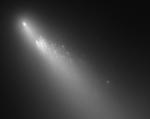 Schwassmann Wachmann 3: Fragment B
4.05.2006
Periodic comet 73P/Schwassmann-Wachmann 3 has fallen apart before. A cosmic souffle of ice and dust left over from the early solar system, this comet was seen to split into several large pieces during the close-in part of its orbit in 1995.
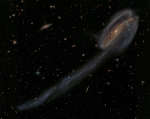 Arp 188 and the Tadpoles Tail
25.08.2014
Why does this galaxy have such a long tail? In this stunning vista, based on image data from the Hubble Legacy Archive, distant galaxies form a dramatic backdrop for disrupted spiral galaxy Arp 188, the Tadpole Galaxy. The cosmic tadpole is a mere 420 million light-years distant toward the northern constellation Draco.
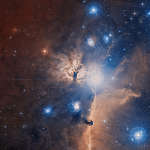 Inside the Flame Nebula
2.11.2019
The Flame Nebula stands out in this optical image of the dusty, crowded star forming regions toward Orion's belt, a mere 1,400 light-years away. X-ray data from the Chandra Observatory and infrared images from the Spitzer Space Telescope can take you inside the glowing gas and obscuring dust clouds though.
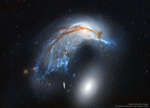 The Porpoise Galaxy from Hubble
10.05.2020
What's happening to this spiral galaxy? Just a few hundred million years ago, NGC 2936, the upper of the two large galaxies shown, was likely a normal spiral galaxy -- spinning, creating stars -- and minding its own business.
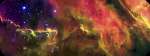 The Southern Cliff in the Lagoon
15.05.2021
Undulating bright ridges and dusty clouds cross this close-up of the nearby star forming region M8, also known as the Lagoon Nebula. A sharp, false-color composite of narrow band visible and broad band near-infrared...
 A Cosmic Zoo in Cepheus
17.08.2023
Sprawling emission nebulae IC 1396 and Sh2-129 mix glowing interstellar gas and dark dust clouds in this nearly 12 degree wide field of view toward the northern constellation Cepheus the King. Energized by its central star IC 1396 (left), is hundreds of light-years across and some 3,000 light-years distant.
|
January February March April May June July August September October |
|||||||||||||||||||||||||||||||||||||||||||||||||