
|
You entered: dust
 Hickson 44 in Leo
4.04.2025
Scanning the skies for galaxies, Canadian astronomer Paul Hickson and colleagues identified some 100 compact groups of galaxies, now appropriately called Hickson Compact Groups. The four prominent galaxies seen in this intriguing telescopic skyscape are one such group, Hickson 44.
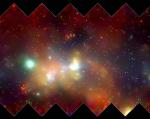 X Ray Milky Way
10.01.2002
If you had x-ray vision, the center regions of our galaxy would not be hidden from view by immense cosmic dust clouds opaque to visible light. Instead, the Milky Way toward Sagittarius might look something like this stunning mosaic of images from the orbiting Chandra Observatory.
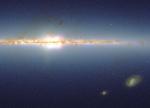 Counting Stars in the Infrared Sky
19.07.2002
The bulging center of our Milky Way Galaxy, dark cosmic clouds, the thin galactic plane, and even nearby galaxies are easy to spot in this sky view. But each pixel in the digital image is actually based on star counts alone -- as derived from the Two Micron All Sky Survey (2MASS) database.
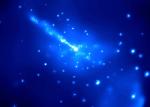 Centaurus A: X-Rays from an Active Galaxy
5.07.2003
Its core hidden from optical view by a thick lane of dust, the giant elliptical galaxy Centaurus A was among the first objects observed by the orbiting Chandra X-ray Observatory. Astronomers were not disappointed, as Centaurus A's appearance in x-rays makes its classification as an active galaxy easy to appreciate.
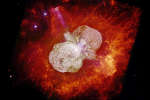 APOD: 2008 June 17- Eta Carinae and the Homunculus Nebula
17.06.2008
How did the star Eta Carinae create this unusual nebula? No one knows for sure. About 165 years ago, the southern star Eta Carinae mysteriously became the second brightest star in the night sky. In 20 years, after ejecting more mass than our Sun, Eta Car unexpected faded.
 A View Toward M101
15.03.2019
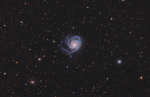
Big, beautiful spiral galaxy M101 is one of the last entries in Charles Messier's famous catalog, but definitely not one of the least. About 170,000 light-years across, this galaxy is enormous, almost twice the size of our own Milky Way galaxy.
 APOD: 2023 March 22 Б M31: The Andromeda Galaxy
22.03.2023
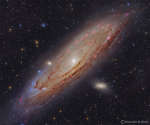
How far can you see? The most distant object easily visible to the unaided eye is M31, the great Andromeda Galaxy, over two million light-years away. Without a telescope, even this immense spiral galaxy appears as an unremarkable, faint, nebulous cloud in the constellation Andromeda.
 APOD: 2026 March 27 Б Hickson 44 in Leo
27.03.2026
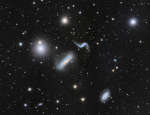
Scanning the skies for galaxies, Canadian astronomer Paul Hickson and colleagues identified some 100 compact groups of galaxies, now appropriately called Hickson Compact Groups. The four prominent galaxies seen in this intriguing telescopic skyscape are one such group, Hickson 44.
 Fireball, Smoke Trail, Meteor Storm
22.11.2001
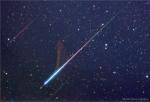
Returning from orbit, space shuttles enter the atmosphere at about 8 kilometers per second as friction heats their protective ceramic tiles to over 1,400 degrees Celsius. By contrast, the bits of comet dust...
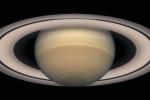 Saturn: Lord of the Rings
17.01.2004
Born in 1564, Galileo used a telescope to explore the Solar System. In 1610, he became the first to be amazed by Saturn's rings, After nearly 400 years, Saturn's magnificent rings still offer one of the most stunning astronomical sights.
|
January February March April May June July August September October |
|||||||||||||||||||||||||||||||||||||||||||||||||