
|
You entered: dust
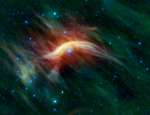 Zeta Oph: Runaway Star
3.02.2011
Like a ship plowing through cosmic seas, runaway star Zeta Ophiuchi produces the arcing interstellar bow wave or bow shock seen in this stunning infrared portrait from the WISE spacecraft. In the false-color view...
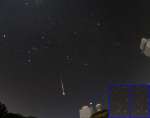 Leonid Fireball over Tenerife
22.11.2011
Historically active, this year's Leonid meteor shower was diminished by bright moonlight. Still, faithful night sky watchers did see the shower peak on November 18 and even the glare of moonlight didn't come close to masking this brilliant fireball meteor.
 M31 versus M33
26.09.2013
Separated by about 14 degrees (28 Full Moons) in planet Earth's sky, spiral galaxies M31 ,left, and M33 are both large members of the Local Group, along with our own Milky Way galaxy.
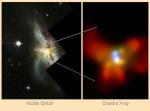 The Supermassive Black Holes of NGC 6240
27.11.2002
The Hubble optical image on the left shows NGC 6240 in the throes of a titanic galaxy - galaxy collision 400 million light-years away. As the cosmic catastrophe plays out, the merging galaxies spew forth distorted tidal tails of stars, gas, and dust and undergo frantic bursts of star formation.
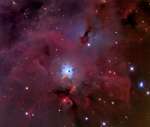 NGC 1999: South of Orion
23.02.2011
South of the large star-forming region known as the Orion Nebula, lies bright blue reflection nebula NGC 1999. Also at the edge of the Orion molecular cloud complex some 1,500 light-years distant, NGC 1999's illumination is provided by the embedded variable star V380 Orionis.
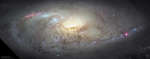 M106 Close Up
3.10.2013
Close to the Great Bear (Ursa Major) and surrounded by the stars of the Hunting Dogs (Canes Venatici), this celestial wonder was discovered in 1781 by the metric French astronomer Pierre Mechain. Later, it was added to the catalog of his friend and colleague Charles Messier as M106.
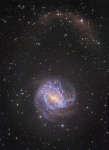 M83 Star Streams
17.01.2014
Big, bright, and beautiful, spiral galaxy M83 lies a mere twelve million light-years away, near the southeastern tip of the very long constellation Hydra. This deep view of the gorgeous island universe includes observations...
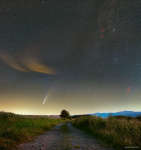 Comet NEOWISE and Nebulae
19.07.2020
Would you brave wild animals to photograph this sky? One astrophotographer did -- and we all get to reap the rewards. First, thousands of stars were visible with many of the brightest impressively blue. Next, several red-glowing nebulae were discernible, including the California Nebula on the far right, and, above it, the Heart and Soul nebulae.
 APOD: 2020 August 26 Б Cygnus Skyscape
25.08.2020
In brush strokes of interstellar dust and glowing hydrogen gas, this beautiful skyscape is painted across the plane of our Milky Way Galaxy near the northern end of the Great Rift and the constellation Cygnus the Swan.
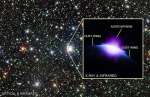 APOD: 2026 March 6 Б The Astrosphere of HD 61005
5.03.2026
Do young stars blow bubbles? The larger view shows a stellar field observed with the Cerro Tololo Inter-American Observatory in Chile, and the inset highlights HD 61005, a star like our Sun, only 120 light-years away.
|
January February March April May June July August September October |
|||||||||||||||||||||||||||||||||||||||||||||||||