
|
You entered: galaxies
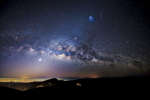 Rocket, Meteor, and Milky Way over Thailand
12.02.2014
Can the night sky appear both serene and surreal? Perhaps classifiable as serene in the above panoramic image taken last Friday are the faint lights of small towns glowing across a dark foreground landscape of Doi Inthanon National Park in Thailand, as well as the numerous stars glowing across a dark background starscape.
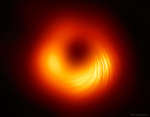 M87s Central Black Hole in Polarized Light
31.03.2021
To play on Carl SaganБs famous words "If you wish to make black hole jets, you must first create magnetic fields." The featured image represents the detected intrinsic spin direction (polarization) of radio waves. The polarizationi is produced by the powerful magnetic field surrounding the supermassive black hole at the center of elliptical galaxy M87.
 Open Star Clusters M35 and NGC 2158
27.02.2025
Framed in this single, starry, telescopic field of view are two open star clusters, M35 and NGC 2158. Located within the boundaries of the constellation Gemini, they do appear to be side by side. Its stars concentrated toward the upper right, M35 is relatively nearby, though.
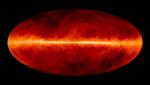 A Sky Full Of Hydrogen
13.01.2001
Interstellar space is filled with extremely tenuous clouds of gas which are mostly Hydrogen. The neutral hydrogen atom (HI in astronomer's shorthand) consists of 1 proton and 1 electron. The proton and electron spin like tops but can have only two orientations; spin axes parallel or anti-parallel.
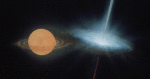 Jets From SS433
6.03.1996
SS433 is one of the most exotic star systems known to astronomers. Its unremarkable name stems from its inclusion in a catalog of stars which emit radiation characteristic of atomic hydrogen. Its very remarkable behavior stems from a compact object, a black hole or neutron star, which has produced an accretion disk with jets.
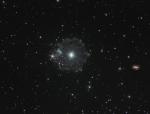 Cat s Eye Wide and Deep
29.06.2007
The Cat's Eye Nebula (NGC 6543) is one of the best known planetary nebulae in the sky. Its more familiar outlines are seen in the the brighter central region of this impressive wide-angle view. But the composite image also combines many short and long exposures to reveal the nebula's extremely faint halo.
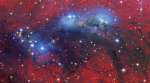 NGC 6914 Nebulae
4.03.2011
A dramatic study in contrasts, this colorful skyscape features stars, dust, and glowing gas in NGC 6914. The complex of nebulae lies some 6,000 light-years away, toward the high-flying northern constellation Cygnus and the plane of our Milky Way Galaxy.
 Visual Effects: Wonders of the Universe
18.04.2011
What visual effects are depicted in this video? The effects were created by BDH for the BBC television show Wonders of the Universe, but are unlabeled on the above version posted to Vimeo. Even...
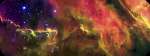 The Southern Cliff in the Lagoon
11.05.2011
Undulating bright ridges and dusty clouds cross this close-up of the nearby star forming region M8, also known as the Lagoon Nebula. A sharp, false-color composite of narrow band visible and broad band near-infrared...
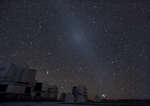 The Gegenschein Over Chile
2.12.2012
Is the night sky darkest in the direction opposite the Sun? No. In fact, a rarely discernable faint glow known as the gegenschein (German for "counter glow") can be seen 180 degrees around from the Sun in an extremely dark sky. The gegenschein is sunlight back-scattered off small interplanetary dust particles.
|
January February March April May June July August September October |
|||||||||||||||||||||||||||||||||||||||||||||||||