
|
You entered: galaxies
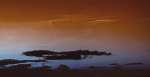 Noctilucent Clouds and Aurora Over Scotland
19.08.2013
Why would the sky still glow after sunset? Besides stars and the band of our Milky Way galaxy, the sky might glow because it contains either noctilucent clouds or aurora. Rare individually, both are visible in the above time lapse movie taken over Caithness, Scotland, UK taken during a single night earlier this month.
 M42: Inside the Orion Nebula
8.04.2014
The Great Nebula in Orion, an immense, nearby starbirth region, is probably the most famous of all astronomical nebulas. Here, glowing gas surrounds hot young stars at the edge of an immense interstellar molecular cloud only 1500 light-years away.
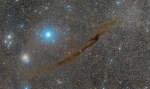 NGC 4372 and the Dark Doodad
10.09.2015
The delightful Dark Doodad Nebula drifts through southern skies, a tantalizing target for binoculars in the constellation Musca, The Fly. The dusty cosmic cloud is seen against rich starfields just south of the prominent Coalsack Nebula and the Southern Cross.
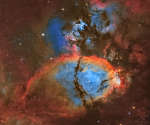 IC 1795: The Fishhead Nebula
31.07.2019
To some, this nebula looks like the head of a fish. However, this colorful cosmic portrait really features glowing gas and obscuring dust clouds in IC 1795, a star forming region in the northern constellation Cassiopeia.
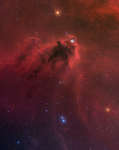 LDN 1622: Dark Nebula in Orion
21.02.2020
The silhouette of an intriguing dark nebula inhabits this cosmic scene. Lynds' Dark Nebula (LDN) 1622 appears against a faint background of glowing hydrogen gas only visible in long telescopic exposures of the region. In contrast, the brighter reflection nebula vdB 62 is more easily seen, just above and right of center.
 Cat s Eye Wide and Deep
25.05.2023
The Cat's Eye Nebula (NGC 6543) is one of the best known planetary nebulae in the sky. Its more familiar outlines are seen in the brighter central region of the nebula in this impressive wide-angle view. But this wide and deep image combining data from two telescopes also reveals its extremely faint outer halo.
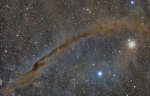 APOD: 2026 July 31 Б NGC 4372 and the Dark Doodad
31.07.2026
The Dark Doodad Nebula drifts through southern skies, a tantalizing target for binoculars toward the small constellation Musca, The Fly. A dusty interstellar cloud, it's seen against rich starfields just south of the Coalsack Nebula and the Southern Cross.
 A Year of Resolving Backgrounds
30.12.2000
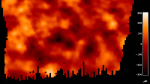
No matter which direction you look, no matter what type of light you see, the sky glows - but why? The sources of many of these background radiations have remained long-standing puzzles, but this millennial year brought some partial resolutions.
 Moon AND Stars
6.09.2001
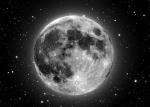
Here's something you don't see too often ... a detailed picture of the full Moon surrounded by a rich field of background stars. It's true that bright moonlight scattered by the atmosphere...
 The Compton Observatory Turns Five
13.04.1996
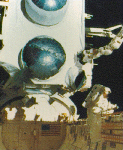
Earlier this April, NASA's Compton Gamma Ray Observatory, completed its fifth successful year in orbit, exploring the gamma ray sky. Pictured is astronaut Jay Apt perched in the shuttle payload bay below the massive observatory. Compton is the largest civilian instrument ever flown - the whole observatory is roughly the size of a school bus.
|
January February March April May June July August September October |
|||||||||||||||||||||||||||||||||||||||||||||||||