
|
You entered: galaxies
 Geminid Meteors over Chile
23.12.2013
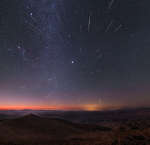
From a radiant point in the constellation of the Twins, the annual Geminid meteor shower rained down on planet Earth over the past few weeks. Recorded near the shower's peak over the night...
 The Wizard Nebula
29.08.2014
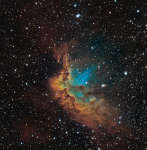
Open star cluster NGC 7380 is still embedded in its natal cloud of interstellar gas and dust popularly known as the Wizard Nebula. Seen with foreground and background stars along the plane of our Milky Way galaxy it lies some 8,000 light-years distant, toward the constellation Cepheus.
 The Tulip and Cygnus X-1
1.09.2022
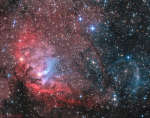
Framing a bright emission region, this telescopic view looks out along the plane of our Milky Way Galaxy toward the nebula rich constellation Cygnus the Swan. Popularly called the Tulip Nebula, the reddish glowing cloud of interstellar gas and dust is also found in the 1959 catalog by astronomer Stewart Sharpless as Sh2-101.
 APOD: 2023 September 27 Б STEVE and Milky Way Cross over Rural Road
27.09.2023
Not every road ends in a STEVE. A week ago, a sky enthusiast's journey began with a goal: to photograph an aurora over Lake Huron. Driving through rural Ontario, Canada, the forecasted sky show started unexpectedly early, causing the photographer to stop before arriving at the scenic Great Lake.
 The Galactic Center A Radio Mystery
28.01.1999
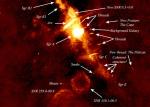
Tuning in to the center of our Milky Way galaxy, radio astronomers explore a complex, mysterious place. A premier high resolution view, this startlingly beautiful picture covers a 4x4 degree region around the galactic center.
 The Local Bubble and the Galactic Neighborhood
12.04.2000
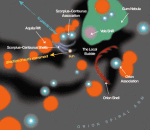
What surrounds the Sun in this neck of the Milky Way Galaxy? Our current best guess is depicted in the above map of the surrounding 1500 light years constructed from various observations and deductions.
 Young Suns of NGC 7129
4.09.2010
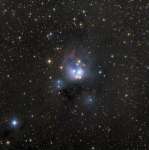
Young suns still lie within dusty NGC 7129, some 3,000 light-years away toward the royal constellation Cepheus. While these stars are at a relatively tender age, only a few million years old, it is likely that our own Sun formed in a similar stellar nursery some five billion years ago.
 N49 s Cosmic Blast
4.07.2003
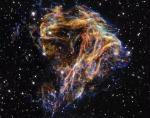
Scattered debris from a cosmic supernova explosion lights up the sky in this gorgeous composited image based on data from the Hubble Space Telescope. Cataloged as N49, these glowing filaments of shocked gas span about 30 light-years in our neighboring galaxy, the Large Magellanic Cloud.
 Structure in N63A
1.01.2004
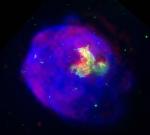
Shells and arcs abound in this false-color, multiwavelength view of supernova remnant N63A, the debris of a massive stellar explosion. The x-ray emission (blue), is from gas heated to 10 million degrees C as knots of fast moving material from the cosmic blast sweep up surrounding interstellar matter.
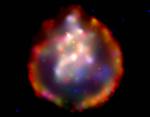 SNR 0103 72.6: Oxygen Supply
13.08.2005
A supernova explosion, a massive star's inevitable and spectacular demise, blasts back into space debris enriched in the heavy elements forged in its stellar core. Incorporated into future stars and planets, these are the elements ultimately necessary for life. Seen here in a false-color x-ray image, supernova remnant SNR 0103-72
|
January February March April May June July August September October |
|||||||||||||||||||||||||||||||||||||||||||||||||