
|
You entered: image
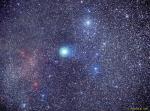 Skyscape with Comet Holmes
9.11.2007
This gorgeous skyscape spans some 10 degrees across the heroic constellation Perseus, about the size of a generous binocular field of view. The deep exposure includes bright stars, emission nebulae, star clusters, and, of course, the famous Comet Holmes. To identify the celestial landmarks, just place your cursor over the image.
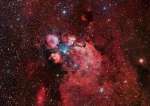 NGC 6334: The Cats Paw Nebula
18.06.2014
Nebulas are perhaps as famous for being identified with familiar shapes as perhaps cats are for getting into trouble. Still, no known cat could have created the vast Cat's Paw Nebula visible in Scorpius.
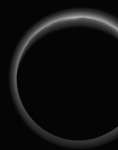 Pluto at Night
9.06.2016
The night side of Pluto spans this shadowy scene. The spacebased view with the Sun behind the distant world was captured by New Horizons last July. The spacecraft was at a range of over 21,000 kilometers, about 19 minutes after its closest approach.
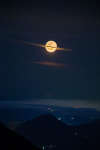 A Moon Dressed Like Saturn
16.03.2020
Why does Saturn appear so big? It doesn't -- what is pictured are foreground clouds on Earth crossing in front of the Moon. The Moon shows a slight crescent phase with most of its surface visible by reflected Earthlight known as ashen glow.
 Fireball over Iceland
16.09.2023
On September 12, from a location just south of the Arctic Circle, stones of Iceland's modern Arctic Henge point skyward in this startling scene. Entertaining an intrepid group of aurora hunters during a geomagnetic storm, alluring northern lights dance across the darkened sky when a stunning fireball meteor explodes.
 APOD: 2025 July 12 Б Clouds and the Golden Moon
12.07.2025
As the Sun set, a bright Full Moon rose on July 10. Its golden light illuminates clouds drifting through southern hemisphere skies in this well-composed telephoto image from Conceiццёo do Coitц, Bahia, Brazil. The brightest lunar phase is captured here with both a short and long exposure.
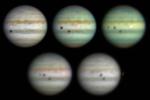 A Triple Eclipse on Jupiter
2.02.1998
Part of Jupiter is missing. Actually, three parts appear to be missing. In reality though, the three dark spots seen in the above photograph are only shadows. The unusual alignment of three of Jupiter's moons between the Jovian giant and the Sun was imaged last November 10th.
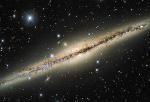 Interstellar Dust Bunnies of NGC 891
3.07.2002
What is going on in NGC 891? This galaxy appeared previously to be very similar to our own Milky Way Galaxy: a spiral galaxy seen nearly edge-on. However, recent high-resolution images of NGC 891's dust show unusual filamentary patterns extending well away from its Galactic disk.
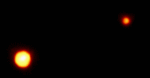 Pluto: The Frozen Planet
18.08.1995
The Hubble Space Telescope imaged Pluto and its moon Charon in 1994. Pluto is usually the most distant planet from the Sun but because of its elliptic orbit Pluto crossed inside of Neptune's orbit in 1979 and will cross back out again in 1999.
 Asteroid Annefrank
13.11.2002
NASA's interplanetary probe STARDUST, on its way to Comet Wild 2 in January 2004, passed asteroid 5535 Annefrank earlier this month. Annefrank, named for a holocaust victim who kept a famous diary, is a member of the main asteroid belt between Mars and Jupiter.
|
January February March April May June July August September |
|||||||||||||||||||||||||||||||||||||||||||||||||