
|
You entered: image
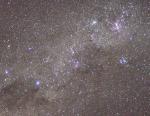 The Southern Sky from the International Space Station
7.05.2003
Look up from Earth's South Pole, and this stellar starscape is what you might see. Alternatively, this patch of sky is also visible from many southern locations as well as the orbiting International Space Station, where the above image was recently recorded.
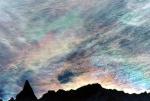 Iridescent Clouds Over Aiguille de la Tsa
14.10.2003
Before the sun rose over the mountains, iridescent colors danced across the sky. The unexpected light show was caused by a batch of iridescent clouds, and captured on film in early September in Arolla, Wallis, Switzerland. The peak in the foreground of the above image is Aiguille de la Tsa.
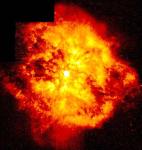 WR124: Stellar Fireball
9.11.1998
Some stars explode in slow motion. Rare, massive Wolf-Rayet stars are so tumultuous and hot they are disintegrating right before our telescopes. Glowing gas globs each over 30 times more massive than the Earth are being expelled by a violent stellar wind.
 The Unusual Blueberries at Bylot Rock
17.08.2004
Why aren't these Martian rocks round? Small rocks dubbed blueberries have been found by the Opportunity rover all over Meridiani Planum on Mars, but the ones perched on Bylot rock have unusually non-spherical shapes. The strangely shaped blueberry rocks are shown above in an image taken by Opportunity's microscopic imager on August 9.
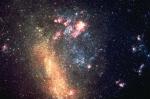 Neighboring Galaxy: The Large Magellanic Cloud
22.02.2000
The brightest galaxy visible from our own Milky Way Galaxy is the Large Magellanic Cloud (LMC). Visible predominantly from Earth's Southern Hemisphere, the LMC is the second closest galaxy, neighbor to the Small Magellanic Cloud, and one of eleven known dwarf galaxies that orbit our Milky Way Galaxy.
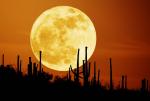 Saguaro Moon
26.09.2007
A Full Moon rising can be a dramatic celestial sight, and Full Moons can have many names. For example, tonight's Full Moon, the one nearest the autumnal equinox in the northern hemisphere, is popularly called the Harvest Moon.
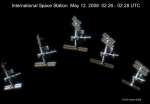 Space Station in the Sun
24.05.2008
Still bathed in sunlight, the International Space Station tracked through night skies above Hombressen, Germany on May 12. From a range of at least 360 kilometers, astronomer Dirk Ewers was able to record...
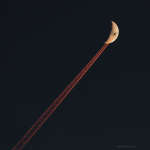 Plane Crossing a Crescent Moon
12.02.2019
No, this is not a good way to get to the Moon. What is pictured is a chance superposition of an airplane and the Moon. The contrail would normally appear white, but the large volume of air toward the setting Sun preferentially knocks away blue light, giving the reflected trail a bright red hue.
 Total Totality
12.04.2024
Baily's beads often appear at the boundaries of the total phase of an eclipse of the Sun. Pearls of sunlight still beaming through gaps in the rugged terrain along the lunar limb silhouette, their appearance is recorded in this dramatic timelapse composite.
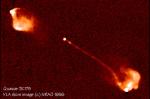 3C175: Quasar Cannon
5.09.2001
3C175 is not only a quasar, it is a galaxy-fueled particle cannon. Visible as the central dot is quasar 3C175, the active center of a galaxy so distant that the light we see from it was emitted when the Earth was just forming.
|
January February March April May June July August September |
|||||||||||||||||||||||||||||||||||||||||||||||||