
|
You entered: image
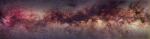 A Milky Way Band
30.09.2007
Most bright stars in our Milky Way Galaxy reside in a disk. Since our Sun also resides in this disk, these stars appear to us as a diffuse band that circles the sky.
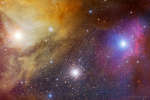 Antares and Clouds
17.04.2012
Antares is a huge star. In a class called red supergiant, Antares is about 850 times the diameter of our own Sun, 15 times more massive, and 10,000 times brighter. Antares is the brightest star in the constellation of Scorpius and one of the brighter stars in all the night sky.
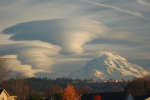 Lenticular Clouds Over Washington
4.11.2012
Are those UFOs near that mountain? No -- they are multilayered lenticular clouds. Moist air forced to flow upward around mountain tops can create lenticular clouds. Water droplets condense from moist air cooled below the dew point, and clouds are opaque groups of water droplets.
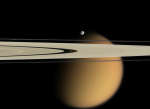 Titan Beyond the Rings
1.11.2014
When orbiting Saturn, be sure to watch for breathtaking superpositions of moons and rings. One such picturesque vista was visible recently to the robot Cassini spacecraft now orbiting Saturn. In 2006 April, Cassini captured Saturn's A and F rings stretching in front of cloud-shrouded Titan.
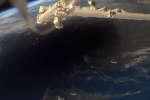 Earth During a Total Eclipse of the Sun
17.03.2015
What does the Earth look like during a total solar eclipse? It appears dark in the region where people see the eclipse, because that's where the shadow of the Moon falls. The shadow...
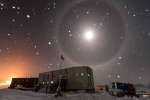 A Blue Moon Halo over Antarctica
11.08.2015
Have you ever seen a halo around the Moon? Such 22 degree rings around the Moon -- caused by ice crystals falling in the Earth's atmosphere -- are somewhat rare. OK, but have you ever seen a blue moon?
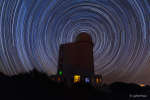 Circumpolar Star Trails
18.01.2019
As Earth spins on its axis, the stars appear to rotate around an observatory in this well-composed image from the Canary Island of Tenerife. Of course, the colorful concentric arcs traced out by the stars are really centered on the planet's North Celestial Pole.
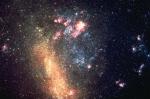 Neighboring Galaxy: The Large Magellanic Cloud
4.08.2001
The brightest galaxy visible from our own Milky Way Galaxy is the Large Magellanic Cloud (LMC). Visible predominantly from Earth's Southern Hemisphere, the LMC is the second closest galaxy, neighbor to the Small Magellanic Cloud, and one of eleven known dwarf galaxies that orbit our Milky Way Galaxy.
 Asteroid 1998 WT24 Passes Near Earth
24.12.2001
Last week, an asteroid approached unusually close to the Earth. Passing well outside the orbit of our Moon, Asteroid 1998 WT24 posed no danger, but became bright enough to see with binoculars and to track with radar. Pictured above, the kilometer-sized asteroid was imaged crossing the sky on December 14, two days before closest approach.
 A Crescent Earth At Midnight
6.10.1996
The Earth's northern hemisphere appears outlined as a sunlit crescent in this dramatic view from the GOES 8 satellite. The image was made near midnight for the Geostationary Operational Environmental Satellite on June 22 this year, two days after the Summer Solstice.
|
January February March April May June July August September |
|||||||||||||||||||||||||||||||||||||||||||||||||