
|
You entered: NASA
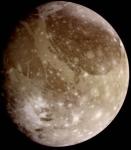 Ganymede: The Largest Moon in the Solar System
20.06.2000
If Ganymede orbited the Sun, it would be considered a planet. The reason is that Jupiter's moon Ganymede is not only the largest moon in the Solar System, it is larger than planets Mercury and Pluto.
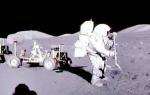 An Apollo 17 Panorama
28.01.2002
What would it be like to stand on the surface of another world, to look all around you, and to try to figure out how this world got there? To get an idea, scroll right. In 1972 during the Apollo 17 mission, astronauts Harrison Schmitt and Eugene Cernan found out first hand.
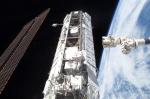 Beefing Up the International Space Station
17.12.2002
The International Space Station (ISS) will be the largest human-made object ever to orbit the Earth. The station is so large that it could not be launched all at once -- it is being built piecemeal with large sections added continually by flights of the Space Shuttle.
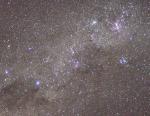 The Southern Sky from the International Space Station
7.05.2003
Look up from Earth's South Pole, and this stellar starscape is what you might see. Alternatively, this patch of sky is also visible from many southern locations as well as the orbiting International Space Station, where the above image was recently recorded.
 The Unusual Blueberries at Bylot Rock
17.08.2004
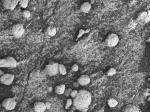
Why aren't these Martian rocks round? Small rocks dubbed blueberries have been found by the Opportunity rover all over Meridiani Planum on Mars, but the ones perched on Bylot rock have unusually non-spherical shapes. The strangely shaped blueberry rocks are shown above in an image taken by Opportunity's microscopic imager on August 9.
 Manicouagan Impact Crater
1.01.2005
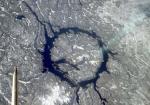
Manicouagan Crater in northern Canada is one of the oldest impact craters known. Formed about 200 million years ago, the present day terrain supports a 70-kilometer diameter hydroelectric reservoir in the telltale form of an annular lake. The crater itself has been worn away by the passing of glaciers and other erosional processes.
 APOD: 2024 August 21 Б Fermis 12 year All Sky Gamma ray Map
21.08.2024
Forget X-ray vision Б imagine what you could see with gamma-ray vision! The featured all-sky map shows what the universe looks like to NASA's Fermi Gamma-ray Space Telescope. Fermi sees light with energies about a billion times what the human eye can see, and the map combines 12 years of Fermi observations.
 M16: Stars from Eagle's EGGs
25.11.2001
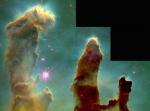
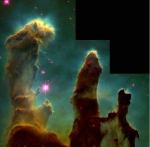
Newborn stars are forming in the Eagle Nebula. This image, taken with the Hubble Space Telescope in 1995, shows evaporating gaseous globules (EGGs) emerging from pillars of molecular hydrogen gas and dust. The giant pillars are light years in length and are so dense that interior gas contracts gravitationally to form stars.
 M16: Stars from Eagle's Eggs
24.09.2000
Newborn stars are forming in the Eagle Nebula. This image, taken with the Hubble Space Telescope in 1995, shows evaporating gaseous globules (EGGs) emerging from pillars of molecular hydrogen gas and dust. The giant pillars are light years in length and are so dense that
 The Search for Life on Mars
21.07.1995
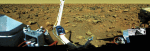
Although images of Mars taken from space revealed the planet to have a barren and cratered surface, scientists did not give up the search for martian life. In 1976 NASA's Viking project succeeded in landing two robot probes on the surface of Mars.
|
January February March April May June July August September October |
|||||||||||||||||||||||||||||||||||||||||||||||||