
|
You entered: NASA
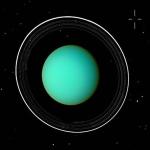 Uranus Moon 18
31.05.1999
The discovery was there for the taking. An image of Uranus taken by Voyager 2 as it passed the giant planet 13 years ago apparently recorded a moon that had since gone unnoticed. The image on which Uranus' 18th moon was discovered was freely available from NASA. Erich Karkoschka (U.
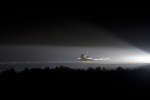 A Last Landing for Space Shuttle Endeavour
7.06.2011
Space shuttle Endeavour is home to stay. In a rare night landing last week, Endeavour glided onto a runway in Cape Canaveral, Florida, USA completing a 16-day mission that included a visit to the International Space Station (ISS).
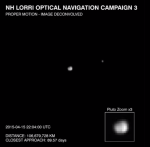 Approaching Pluto
27.05.2015
Here comes Pluto. NASA's robotic New Horizons spacecraft is now beyond the orbit of Neptune and closing fast on the Solar System's most famous unexplored world. The featured time lapse video shows...
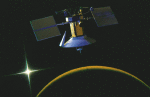 A World Explorer
25.08.1995
Ferdinand Magellan was a world explorer. Many consider him the greatest navigator of Europe's 16th century age of sea going exploration and credit his expedition with the first circumnavigation of planet Earth. NASA...
 The Flight of Helios
20.12.2003
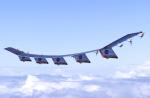
An example of solar-powered flight, NASA's Helios aircraft flew almost one hundred years after the Wright brothers' historic flight on December 17, 1903. Pictured here at 10,000 feet in in skies northwest of Kauai, Hawaii in August 2001, the remotely piloted Helios is traveling at about 25 miles per hour.
 Landing on Mars: Seven Minutes of Terror
15.02.2021
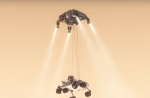
Starting Thursday, there may be an amazing new robotic explorer on Mars. Or there may be a new pile of junk. It all likely depends on things going correctly in the minutes after the Mars 2020 mission arrives at its new home planet and attempts to deploy the Perseverance rover.
 Marius Hills: Holes in the Moon
25.10.2017
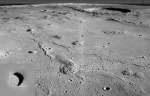
Could humans live beneath the surface of the Moon? This intriguing possibility was bolstered in 2009 when Japan's Moon-orbiting SELENE spacecraft imaged a curious hole beneath the Marius Hills region on the Moon, possibly a skylight to an underground lava tube.
 Dark Sky, Bright Sun
17.05.2003
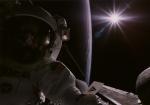
In low Earth orbit there is not enough atmosphere to diffuse and scatter sunlight, so shadows are black and the sky is dark - even when the Sun shines. The harsh lighting produced this dramatic...
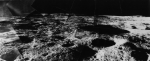 Surveyor Hops
5.12.1998
This panorama of the cratered lunar surface was constructed from images returned by the US Surveyor 6 lander. Surveyor 6 was not the first spacecraft to accomplish a soft landing on the Moon ... but it was the first to land and then lift off again!
 Astronaut Exploring: An Apollo 15 Panorama
11.11.2018
What would it be like to explore the Moon? NASA's Apollo missions gave humans just this chance in the late 1960s and early 1970s. In particular, the Apollo 15 mission was dedicated to better understanding the surface of the Moon by exploring mountains, valleys, maria, and highlands.
|
January February March April May June July August September October |
|||||||||||||||||||||||||||||||||||||||||||||||||