
|
You entered: NASA
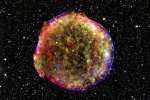 Tychos Supernova Remnant
16.03.2009
What star created this huge puffball? Pictured above is the best multi-wavelength image yet of Tycho's supernova remnant, the result of a stellar explosion first recorded over 400 years ago by the famous astronomer Tycho Brahe.
 A Double Ringed Basin on Mercury
7.10.2009
What created the internal second ring of this double ringed basin on Mercury? No one is sure. The unusual feature spans 160 kilometers and was imaged during the robotic MESSENGER spacecraft's swing past our Solar System's innermost planet last week.
 Voorwerpjes in Space
3.04.2015
Mysterious Hanny's Voorwerp, Dutch for "Hanny's Object", is really enormous, about the size of the Milky Way Galaxy and glowing strongly in the greenish light produced by ionized oxygen atoms.
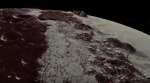 Pluto Flyover from New Horizons
30.07.2017
What if you could fly over Pluto -- what might you see? The New Horizons spacecraft did just this in 2015 July as it shot past the distant world at a speed of about 80,000 kilometers per hour.
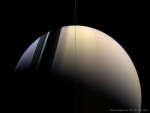 Saturn in Blue and Gold
28.08.2017
Why is Saturn partly blue? The featured picture of Saturn approximates what a human would see if hovering close to the giant ringed world. The image was taken in 2006 March by the robot Cassini spacecraft now orbiting Saturn. Here Saturn's majestic rings appear directly only as a thin vertical line.
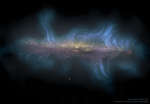 The Vertical Magnetic Field of NGC 5775
26.01.2021
How far do magnetic fields extend up and out of spiral galaxies? For decades astronomers knew only that some spiral galaxies had magnetic fields. However, after NRAO's Very Large Array (VLA) radio telescope...
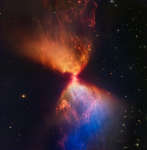 The Protostar within L1527
17.11.2022
The protostar within dark cloud L1527 is a mere 100,000 years old, still embedded in the cloud of gas and dust that feeds its growth. In this NIRCam image from the James Webb...
 APOD: 2025 April 14 Б The Galactic Center in Radio from MeerKAT
13.04.2025
What's happening at the center of our galaxy? It's hard to tell with optical telescopes since visible light is blocked by intervening interstellar dust. In other bands of light, though, such as radio, the galactic center can be imaged and shows itself to be quite an interesting and active place.
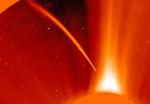 Sungrazer
25.02.1997
Arcing toward a fiery fate, this Sungrazer comet was recorded by the SOHO spacecraft's Large Angle Spectrometric COronagraph (LASCO) on Dec. 23rd, 1996. LASCO uses an occulting disk, partially visible at the lower...
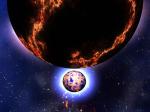 Short Gamma Ray Bursts Localized
17.10.2005
What causes gamma-ray bursts? The most energetic type of explosions known in the cosmos has been an enigma since discovered over 30 years ago. It now appears that there may not be one unique type of progenitor.
|
January February March April May June July August September October |
|||||||||||||||||||||||||||||||||||||||||||||||||