
|
You entered: NASA
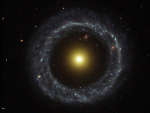 Hoags Object: A Strange Ring Galaxy
28.07.2013
Is this one galaxy or two? This question came to light in 1950 when astronomer Art Hoag chanced upon this unusual extragalactic object. On the outside is a ring dominated by bright blue stars, while near the center lies a ball of much redder stars that are likely much older.
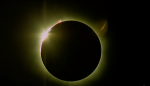 Cheering a Total Solar Eclipse
15.03.2016
What would you do if you saw the Sun disappear? Quite possibly: cheer. That's what many exuberant sky watchers did across Indonesia during a total eclipse of the Sun last week. There and then, the land and sky went dark during the day as our Sun disappeared for a few minutes behind our Moon.
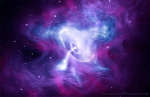 The Spinning Pulsar of the Crab Nebula
21.08.2022
At the core of the Crab Nebula lies a city-sized, magnetized neutron star spinning 30 times a second. Known as the Crab Pulsar, it is the bright spot in the center of the gaseous swirl at the nebula's core.
 APOD: 2024 March 18 Б Comet Pons Brooks Swirling Coma
18.03.2024
A bright comet will be visible during next month's total solar eclipse. This very unusual coincidence occurs because Comet 12P/Pons-Brooks's return to the inner Solar System places it by chance only 25 degrees away from the Sun during Earth's April 8 total solar eclipse.
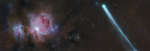 APOD: 2026 May 12 Б The Conjunction of Comet R3 PanSTARRS and the Orion Nebula
12.05.2026
TodayБs composite image features something old, something new, something borrowed, and something blue! Comet R3 PanSTARRS, streaking across the right of the image, likely originated from the Oort Cloud, meaning it is an old Solar System relic from billions of years ago.
 Pioneer 10: The First 6 Billion Miles
3.03.1997
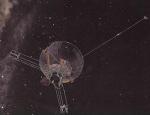
Q: What was made by humans and is 6 billion miles away? A: Pioneer 10 - and yesterday was the 25th anniversary of its launch. More than 9 light hours distant, Pioneer 10 is presently about twice as far from the Sun as Pluto, bound for interstellar space at 28,000 miles per hour.
 P2010 A2: Unusual Asteroid Tail Implies Powerful Collision
3.02.2010
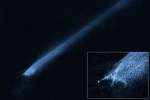
What is this strange object? First discovered on ground based LINEAR images on January 6, the object appeared unusual enough to investigate further with the Hubble Space Telescope last week. Pictured above, what Hubble saw indicates that P/2010 A2 is unlike any object ever seen before.
 Binary Black Hole in 3C 75
14.03.2010
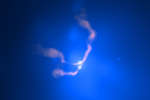
What's happening in the middle of this massive galaxy? There, two bright sources at the center of this composite x-ray (blue)/radio (pink) image are thought to be co-orbiting supermassive black holes powering the giant radio source 3C 75.
 The Hubble Ultra Deep Field in Light and Sound
5.03.2018
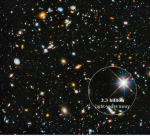
Have you heard about the Hubble Ultra-Deep Field? Either way, you've likely not heard about it like this -- please run your pointer over the featured image and listen! The Hubble Ultra-Deep Field (HUDF)...
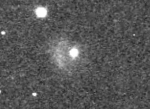 Expanding Plume from DARTs Impact
5.10.2022
What happens if you crash a spaceship into an asteroid? In the case of NASA's DART spaceship and the small asteroid Dimorphos, as happened last week, you get quite a plume. The goal...
|
January February March April May June July August September October |
|||||||||||||||||||||||||||||||||||||||||||||||||