
|
You entered: NASA
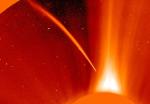 Sungrazer
20.05.2000
Arcing toward a fiery fate, this Sungrazer comet was recorded by the SOHO spacecraft's Large Angle Spectrometric COronagraph (LASCO) on Dec. 23rd, 1996. LASCO uses an occulting disk, partially visible at the lower...
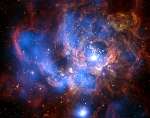 NGC 604: X rays from a Giant Stellar Nursery
5.02.2009
Some 3 million light-years distant in nearby spiral galaxy M33, giant stellar nursery NGC 604 is about 1,300 light-years across, or nearly 100 times the size of the Orion Nebula. In fact, among...
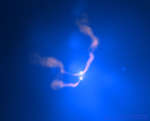 Two Black Holes Dancing in 3C 75
22.10.2017
What's happening at the center of active galaxy 3C 75? The two bright sources at the center of this composite x-ray (blue)/ radio (pink) image are co-orbiting supermassive black holes powering the giant radio source 3C 75.
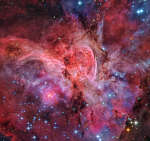 Carina Nebula Close Up
15.02.2020
A jewel of the southern sky, the Great Carina Nebula, also known as NGC 3372, spans over 300 light-years, one of our galaxy's largest star forming regions. Like the smaller, more northerly Great...
 APOD: 2023 July 25 Б The Eagle Nebula with Xray Hot Stars
25.07.2023
What do the famous Eagle Nebula star pillars look like in X-ray light? To find out, NASA's orbiting Chandra X-ray Observatory peered in and through these interstellar mountains of star formation.
 Supernova Remnant Cassiopeia A
14.12.2023
Massive stars in our Milky Way Galaxy live spectacular lives. Collapsing from vast cosmic clouds, their nuclear furnaces ignite and create heavy elements in their cores. After only a few million years for the most massive stars, the enriched material is blasted back into interstellar space where star formation can begin anew.
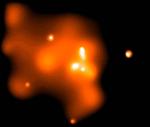 X-Rays From The Galactic Center
20.01.2000
Exploring quasars and active galaxies in the distant universe, astronomers have come to believe that most galaxies have massive black holes at their centers. Swirling stars and a strong, variable radio source offer convincing evidence that even our own Milky Way galaxy's center harbors such a bizarre object, a mere 30,000 light-years away.
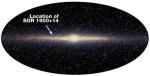 Magnetar In The Sky
22.01.2000
Indicated on this infrared image of the galactic center region is the position of SGR 1900+14 - the strongest known magnet in the galaxy. SGR 1900+14 is believed to be a city-sized, spinning, super-magnetic neutron star, or Magnetar. How strong is a Magnetar's magnetic field?
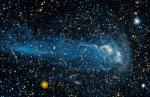 The Tail of a Wonderful Star
17.08.2007
To seventeenth century astronomers, Omicron Ceti or Mira was known as a wonderful star, a star whose brightness could change dramatically in the course of about 11 months. Mira is now seen as the archetype of an entire class of long-period variable stars.
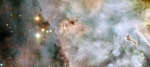 Massive Stars Resolved in the Carina Nebula
1.12.2008
How massive can stars be? Big, hefty stars live short violent lives that can profoundly affect their environments. Isolating a massive star can be problematic, however, since what seems to be a single bright star might actually turn out to be several stars close together.
|
January February March April May June July August September October |
|||||||||||||||||||||||||||||||||||||||||||||||||