
|
You entered: NASA
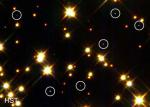 White Dwarf Stars Cool
10.09.2000
Diminutive by stellar standards, white dwarf stars are also intensely hot ... but they are cooling. No longer do their interior nuclear fires burn, so they will continue to cool until they fade away. This Hubble Space Telescope image covers a small region near the center of a globular cluster known as M4.
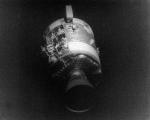 Damage to Apollo 13
19.05.2001
In April of 1970, after an oxygen tank exploded and crippled their service module, the Apollo 13 astronauts were forced to abandon plans to make the third human lunar landing. The extent...
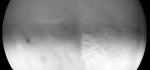 A Global Dust Storm on Mars
1.10.2001
A dust storm on Mars can involve nearly the entire planet. As spring descended on the southern hemisphere of the red planet this June and July, a global dust storm raged. Pictured above is the storm on July 8 as it spread up from the south, oriented on the lower right.
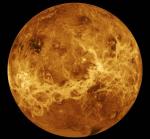 Venus Unveiled
30.03.2002
The surface of Venus is perpetually covered by a veil of thick clouds and remains hidden from even the powerful telescopic eyes of earth-bound astronomers. But in the early 1990s, using imaging radar...
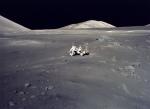 Apollo 17 Lunarscape: A Magnificent Desolation
9.11.2003
Buzz Aldrin, Apollo 11 Lunar Module pilot and the second human to walk on the Moon, described the lunar landscape as "a magnificent desolation". Dramatic pictures from the Apollo missions to the lunar surface testify to this apt turn of phrase.
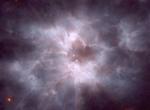 NGC 2440: Cocoon of a New White Dwarf
23.01.2005
Like a butterfly, a white dwarf star begins its life by casting off a cocoon that enclosed its former self. In this analogy, however, the Sun would be a caterpillar and the ejected shell of gas would become the prettiest of all!
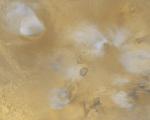 Tharsis Volcanos
18.06.1999
Ice crystal clouds float above the immense Tharsis volcanos of Mars in this recently released picture from NASA's Mars Global Surveyor spacecraft. Olympus Mons at the upper left is 340 miles across and almost 15 miles high - the largest volcano in the solar system.
 3D Bennu
18.10.2025
Put on your red/blue glasses and float next to asteroid 101955 Bennu. Shaped like a spinning toy top with boulders littering its rough surface, the tiny Solar System world is about one Empire State Building (less than 500 meters) across.
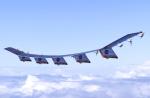 The Flight of Helios
31.08.2001
Solar-powered, remotely piloted, and flying at about 25 miles per hour, NASA's Helios aircraft, is pictured above at 10,000 feet in skies northwest of Kauai, Hawaii on August 13. This ultralight propeller driven aircraft, essentially a flying wing with 14 electric engines, was built by AeroVironment Inc.
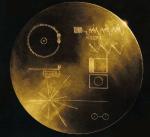 The Voyagers' Message in a Bottle
31.08.2002
Launched twenty-five years ago, NASA's Voyager 1 and 2 spacecraft are now over 10 billion kilometers from the Sun. Still operational, the Voyagers are being tracked and commanded through the Deep Space Network.
|
January February March April May June July August September October |
|||||||||||||||||||||||||||||||||||||||||||||||||