
|
You entered: NASA
 A String Of Pearls
25.05.2002
Comet Shoemaker-Levy 9, named after its co-discoverers, was often referred to as the "string of pearls" comet. It is famous for its suggestive appearance as well as its collision with the planet Jupiter!
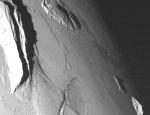 Io at Sunset
20.01.2003
How tall are mountains on Jupiter's moon Io? One way to find out is to view them at sunset. Tall structures facing the Sun are then better-lit and cast long shadows. The above...
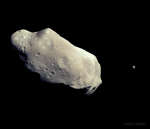 Ida and Dactyl: Asteroid and Moon
17.10.2025
This asteroid has a moon. The robot spacecraft Galileo enroute to explore the Jovian system in 1993, encountered and photographed two asteroids during its long interplanetary voyage. The second minor planet it photographed, 243 Ida, was discovered to have a moon.
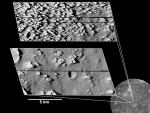 Jagged Hills on Jupiters Callisto
28.08.2001
Why does Jupiter's moon Callisto have unusual jagged hills? This mystery came to light after the robot spacecraft Galileo, in orbit around Jupiter since 1995, swooped past the dark moon in May. The resulting pictures were the highest resolution yet obtained for a Jovian moon: objects as small as 3 meters across are discernable.
 Neptune's Great Dark Spot: Gone But Not Forgotten
1.12.2001
When NASA's Voyager 2 spacecraft flew by distant Neptune in August of 1989, astronomers were shocked. Since Neptune receives only 3 percent the sunlight Jupiter does, they expected to find a dormant, dark, frigid planet. Instead, the Voyager images revealed evidence of a dynamic and turbulent world.
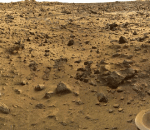 20 Years Ago: Vikings on Mars
20.07.1996
On July 20, 1976, NASA's Viking 1 lander become the first spacecraft to land on Mars, followed weeks later by its twin robot explorer, the Viking 2 lander. Operating on the Martian surface...
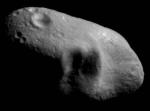 NEAR Shoemaker Views Eros
16.03.2000
Orbiting asteroid 433 Eros, 145 million miles from Earth, NASA's NEAR spacecraft has been returning stunning views as its year long mission of exploration gets underway. A mosaic of recent NEAR images recorded...
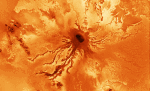 Closeup of an Io Volcano
4.08.1995
In 1979, one of NASA's Voyager spacecraft made a spectacular and unexpected discovery. Io, the innermost Galilean moon of Jupiter, was covered with volcanoes and some of them were erupting! In all, Voyager 1 observed nine volcanic eruptions during its encounter with the moon.
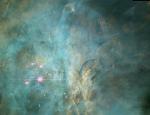 In the Center of the Trapezium
2.03.2003
Start with the constellation of Orion. Near Orion's belt is a fuzzy area known as the Great Nebula of Orion or M42. In this nebula is a bright star cluster known as the Trapezium, shown above. New stellar systems are forming there in gigantic globs of gas and dust known as Proplyds.
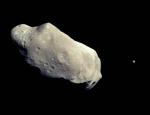 Ida and Dactyl: Asteroid and Moon
19.06.2004
This asteroid has a moon! The robot spacecraft Galileo destined to explore the Jovian system, encountered and photographed two asteroids during its long interplanetary voyage to Jupiter. The second asteroid it photographed, Ida, was discovered to have a moon which appears as a small dot to the right of Ida in this image from 1993.
|
January February March April May June July August September October |
|||||||||||||||||||||||||||||||||||||||||||||||||