
|
You entered: NASA
 Polar Polygons on Mars
14.07.2004
What's the best way to the city center? What looks like a street map of some city on Earth is actually a series of naturally-formed fragmented polar polygons on Mars. The existence...
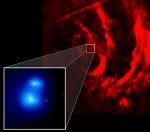 Around The Arches Cluster
14.06.2001
The most compact cluster of stars known in our galaxy, the Arches cluster, boasts 100 or so massive, young stars contained within a diameter of one light-year. Seen toward the constellation Sagittarius, the Arches...
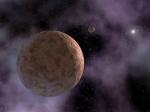 Sedna of the Outer Solar System
16.03.2004
What is the most distant known object in our Solar System? A new answer to this centuries-old question was announced yesterday by NASA with the discovery of a dark red object dubbed Sedna. Although over twice the distance to Pluto, Sedna is near its closest approach to the Sun.
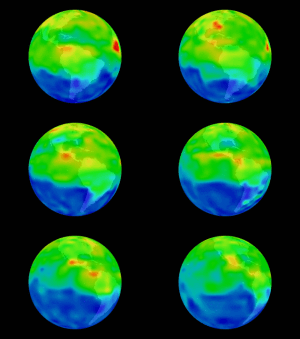 Air Pollution Earth
9.07.2001
Where on Earth is the air most polluted? Recently released images from the Terra satellite show not only areas of high pollution, but also how polluted air moves. In the above image, locations of higher air pollution are shown in red. The pollutant tracked is carbon monoxide (CO) at a height of about 5 kilometers.
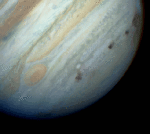 Comet Impacts on Jupiter
14.07.1995
In July of 1994, pieces of Comet Shoemaker-Levy 9, also known as the "string of pearls" comet, collided with the planet Jupiter. As the comet fragments smashed in to Jupiter, the resulting explosions scattered large quantities of dusty cometary debris into the Jovian atmosphere.
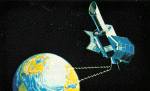 The International Ultraviolet Explorer
29.09.1995
The International Ultraviolet Explorer (IUE) was launched by a NASA Delta rocket in 1978 to provide a space telescope for ultraviolet astronomy. A collaborative project among NASA, ESA and the British SRC (now PPARC) agencies, IUE's estimated lifetime was 3 to 5 years.
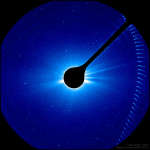 Comet Machholz Approaches the Sun
13.11.2017
Why is Comet Maccholz so depleted of carbon-containing chemicals? Comet 96P/Machholz's original fame derives from its getting closer to the Sun than any other short period comet -- half as close as Mercury -- and doing so every five years.
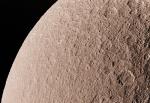 Rhea: Saturn's Second Largest Moon
8.06.2003
Rhea is the second largest moon of Saturn, behind Titan, and the largest without an atmosphere. It is composed mostly of water ice, but has a small rocky core. Rhea's rotation and orbit are locked together (just like Earth's Moon) so that one side always faces Saturn.
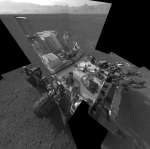 Curiosity on Mars: Still Life with Rover
18.08.2012
What does the Curiosity rover look like on Mars? To help find out, NASA engineers digitally synthesized multiple navigation camera images taken last week into what appears to be the view of a single camera. Besides clods of Martian dirt, many of Curiosity's science instruments are visible and appear in good shape.
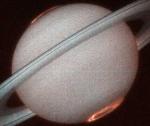 Saturnian Aurora
17.09.2000
Girdling the second largest planet in the Solar System, Saturn's Rings are one of the most spectacular sights for earthbound telescopes. This image from the orbiting Hubble Space Telescope's STIS instrument, offers a striking view of another kind of ring around Saturn - pole encircling rings of ultraviolet aurora.
|
January February March April May June July August September October |
|||||||||||||||||||||||||||||||||||||||||||||||||