
|
You entered: NASA
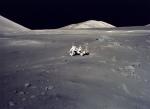 Apollo 17 Lunarscape: A Magnificent Desolation
9.12.2000
Buzz Aldrin, Apollo 11 Lunar Module pilot and the second human to walk on the Moon, described the lunar landscape as "a magnificent desolation". Dramatic pictures from the Apollo missions to the lunar surface testify to this apt turn of phrase.
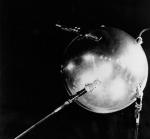 Sputnik: Traveling Companion
3.10.1998
Sputnik means "traveling companion". Despite the innocuous sounding name, the launch of the Earth's first "artificial moon", Sputnik 1, by the Soviets on October 4, 1957 shocked the free world, setting in motion events which resulted in the creation of NASA and the race to the Moon.
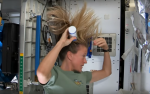 How to Wash Your Hair in Space
20.12.2017
How can you wash your hair in space -- without gravity? Long a bother for space-faring astronauts, Karen Nyberg, a flight engineer on the International Space Station (ISS) in 2013, gave a tutorial. Key components are a squirt package of water, no-rinse shampoo, and vigorous use of a towel and comb.
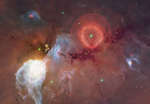 Massive Shell Expelling Star G79 29 0 46
25.09.2017
Stars this volatile are quite rare. Captured in the midst of dust clouds and visible to the right and above center is massive G79.29+0.46, one of less than 100 luminous blue variable stars (LBVs) currently known in our Galaxy.
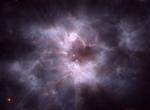 NGC 2440: Cocoon of a New White Dwarf
30.07.2000
Like a butterfly, a white dwarf star begins its life by casting off a cocoon that enclosed its former self. In this analogy, however, the Sun would be a caterpillar and the ejected shell of gas would become the prettiest of all!
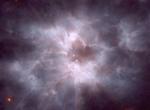 NGC 2440: Cocoon of a New White Dwarf
5.08.2001
Like a butterfly, a white dwarf star begins its life by casting off a cocoon that enclosed its former self. In this analogy, however, the Sun would be a caterpillar and the ejected shell of gas would become the prettiest of all!
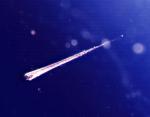 Catching Falling Stardust
17.11.2001
This carrot-shaped track is actually little more than 5 hundredths of an inch long. It is the trail of a meteroid through the high-tech substance aerogel exposed to space by the shuttle launched EURECA (European Recoverable Carrier) spacecraft.
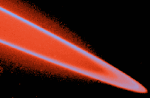 Jupiter's Rings
2.08.1995
Astronomers using NASA's Voyager spacecraft to search for a ring system around Jupiter discovered these faint rings in 1979. Unlike Saturn's bright rings which are composed of chunks of rock and ice, Jupiter's rings appear to consist of fine particles of dust.
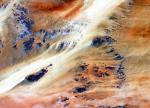 Terkezi Oasis in the Sahara Desert
12.11.2002
Dominating the top third of Africa is the largest band of dry land on Earth: the Sahara Desert. Stretching across the Sahara are vast planes of sand and gravel, seas of sand dunes, and barren rocky mountains.
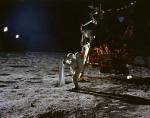 Apollo 11: Catching Some Sun
20.09.2003
Bright sunlight glints and long dark shadows dramatize this image of the lunar surface taken by Apollo 11 astronaut Neil Armstrong, the first to walk on the Moon. Pictured is the mission's lunar...
|
January February March April May June July August September October |
|||||||||||||||||||||||||||||||||||||||||||||||||