
|
You entered: surface
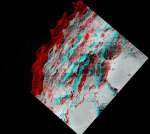 3D 67P
31.03.2017
Get out your red/cyan glasses and gaze across the surface of Churyumov-Gerasimenko, aka Comet 67P. The stereo anaglyph was created by combining two images from the Rosetta spacecraft's narrow angle OSIRIS camera taken on September 22, 2014.
 Odysseus on the Moon
2.03.2024
Methalox rocket engine firing, Odysseus' landing legs absorb first contact with the lunar surface in this wide-angle snapshot from a camera on board the robotic Intuitive Machines Nova-C moon lander. Following the landing on February 22, broken landing legs, visible in the image, ultimately left the lander at rest but tilted.
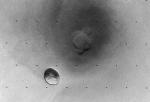 Phobos Over Mars
13.03.1999
Hurtling through space a mere 3,000 miles above the Martian surface, the diminutive moon Phobos (below and left of center) was imaged against the backdrop of a large shield volcano by the Viking 2 Orbiter in 1977.
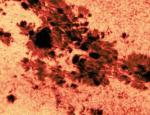 Sunspots: Magnetic Depressions
13.01.1997
Our Sun has spots! These spots appear dark in photographs like the one above, but in fact sunspots are quite bright - they are just dark compared to the rest of the Sun. Sunspots are about the size of the Earth and frequently occur in groups, as shown above.
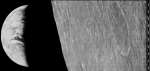 Lunar Orbiter Earthset
27.08.2016
August 10th was the 50th anniversary of the launch of Lunar Orbiter 1. It was the first of five Lunar Orbiters intended to photograph the Moon's surface to aid in the selection of future landing sites.
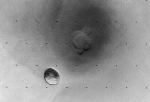 Phobos Over Mars
15.10.1996
Hurtling through space a mere 3,000 miles above the Martian surface, the diminutive moon Phobos (below and left of center) was imaged against the backdrop of a large shield volcano by the Viking 2 Orbiter in 1977.
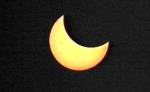 A Partial Eclipse in Southern Skies
3.09.1997
Location is everything, especially if you want to see a Solar Eclipse. These fleeting events are only visible to those in the path of the Moon's shadow as it races across the Earth.
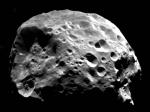 Phoebe: Comet Moon of Saturn
30.06.2004
Was Saturn's moon Phoebe once a comet? Images from the robotic Cassini spacecraft taken two weeks ago when entering the neighborhood of Saturn indicate that Phoebe may have originated in the outer Solar System.
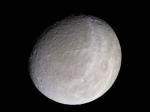 Saturns Moon Rhea from Cassini
15.02.2005
Each moon of Saturn seems to come with its own mystery. Rhea, Saturn's second largest moon behind Titan, shows unusual wisps, visible above as light colored streaks. Higher resolution images of the wisps show them to be made of long braided fractures.
 Follow The Spots
21.10.1999
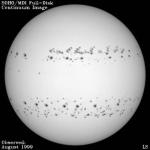
The Sun rotates on its axis about once every 27 days. How can you tell? Just follow the sunspots. This composite picture was constructed from solar images recorded daily by the MDI instrument on board the space-based SOlar and Heliospheric Observatory (SOHO).
|
January February March April May June July August September October |
|||||||||||||||||||||||||||||||||||||||||||||||||