
|
You entered: surface
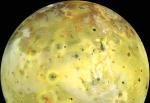 Io in True Color
20.09.1999
The strangest moon in the Solar System is bright yellow. This recently released picture, showing Io's true colors, was taken in July by the Galileo spacecraft currently orbiting Jupiter. Io's colors derive from sulfur and molten silicate rock. The unusual surface of Io is kept very young by its system of active volcanoes.
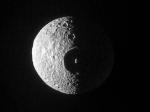 Crater on Mimas
8.03.2005
Whatever hit Mimas nearly destroyed it. What remains is one of the largest impact craters on one of Saturn's smallest moons. The crater, named Herschel after the 1789 discoverer of Mimas, Sir William Herschel, spans about 130 kilometers and is pictured above in the dramatic light of its terminator.
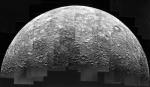 Mercury: A Cratered Inferno
19.08.2001
Mercury's surface looks similar to our Moon's. Each is heavily cratered and made of rock. Mercury's diameter is about 4800 km, while the Moon's is slightly less at about 3500 km (compared with about 12,700 km for the Earth). But Mercury is unique in many ways.
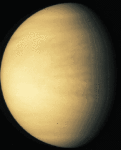 Venus: Earth's Sister Planet
15.08.1995
This picture in visible light was taken by the Galileo spacecraft. Venus is very similar to Earth in size and mass - and so is sometimes referred to as Earth's sister planet - but Venus has a quite different climate.
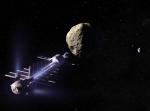 Gravitational Tractor
10.11.2005
How would you change the course of an Earth-threatening asteroid? One idea - a massive spacecraft that uses gravity as a towline - is illustrated in this dramatic artist's view of a gravitational tractor in action.
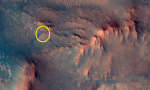 APOD: 2026 June 27 Б Mars Marathon by Perseverance
27.06.2026
In this recent HiRISE view from the Mars Reconnaissance Orbiter, the little green dot indicated on the surface of the big Red Planet is the Perseverance Mars rover. Recorded on June 13, the car-sized...
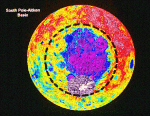 The Largest Impact Crater
6.09.1996
What is the largest known impact crater in the Solar System? Over 1300 miles across, the South Pole-Aitken Basin on the farside of Earth's Moon holds that distinction. Circled above in a false color mosaic of Clementine images it was caused when an asteroid or comet sized object crashed
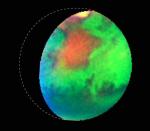 Infrared Mars
3.03.1999
Was Mars wetter and more Earth-like in its distant past? This false-color composite image of Mars is part of the mounting evidence that liquid water once did play a significant role in Martian surface geology.
 Leaving Earth
5.08.2013
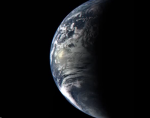
What it would look like to leave planet Earth? Such an event was recorded visually in great detail by the MESSENGER spacecraft as it swung back past the Earth, eight years ago, on its way in toward the planet Mercury. Earth can be seen rotating in this time-lapse video, as it recedes into the distance.
 The Crater Chain
15.07.1995
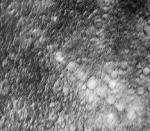
NASA's robot spaceprobe Voyager 1, took this closeup image of the surface of Jupiter's crater scarred moon Callisto in 1979. A mysterious chain of craters is seen to extend diagonally across the image (upper left to lower right). What could cause the craters to line up in such a regular fashion?
|
January February March April May June July August September October |
|||||||||||||||||||||||||||||||||||||||||||||||||