
|
You entered: stars
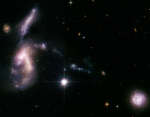 Galaxy Group Hickson 31
22.02.2010
Will the result of these galactic collisions be one big elliptical galaxy? Quite possibly, but not for another billion years. Pictured above, several of the dwarf galaxies of in the Hickson Compact Group 31 are seen slowly merging.
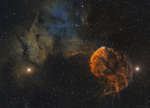 Sharpless 249 and the Jellyfish Nebula
7.03.2019
Normally faint and elusive, the Jellyfish Nebula is caught in this alluring telescopic field of view. The entire scene is a two panel mosaic constructed using narrowband image data, with emission from sulfur, hydrogen and oxygen atoms shown in red, green and blue hues.
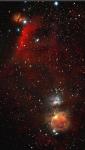 Orion Nebulosities
30.05.2002
Adrift 1,500 light-years away in one of the night sky's most recognizable constellations, the glowing Orion Nebula and the dark Horsehead Nebula are contrasting cosmic vistas. They both appear in this stunning composite color photograph along with other nebulosities as part of the giant Orion Molecular Cloud complex, itself hundreds of light-years across.
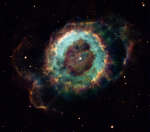 NGC 6369: The Little Ghost Nebula
28.10.2017
Wraithlike NGC 6369 is a faint apparition in night skies popularly known as the Little Ghost Nebula. It was discovered by 18th century astronomer Sir William Herschel as he used a telescope to explore the medicinal constellation Ophiucus. Herschel historically classified the round and planet-shaped nebula as a Planetary Nebula.
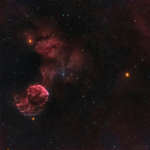 The Jellyfish and Mars
19.05.2021
Normally faint and elusive, the Jellyfish Nebula is caught in this alluring scene. In the telescopic field of view two bright yellowish stars, Mu and Eta Geminorum, stand just below and above the Jellyfish Nebula at the left. Cool red giants, they lie at the foot of the celestial twin.
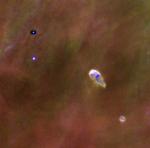 Trapezium: Teardrops in My Skies
28.02.1999
Sometimes the unexpected comes in a familiar shape. In this picture, the seemingly familiar teardrop-shaped object just right of center is actually an unusually situated disk of gas and dust. In fact, the teardrop is about the size of our own Solar System and is racing against time to condense and form planets.
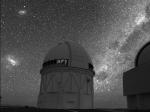 A Cerro Tololo Sky
6.08.2006
High atop a Chilean mountain lies one of the premier observatories of the southern sky: the Cerro Tololo Inter-American Observatory (CTIO). Pictured above is the dome surrounding one of the site's best known instruments, the 4-meter Blanco Telescope.
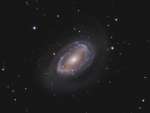 One Armed Spiral Galaxy NGC 4725
6.06.2009
While most spiral galaxies, including our own Milky Way, have two or more spiral arms, NGC 4725 seems to have only one. In this sharp color image, the solo spira mirabilis is tightly wound, traced by bluish, newborn star clusters.
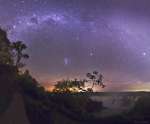 Iguacu Starry Night
14.05.2010
The arc of the southern Milky Way shone brightly on this starry night. Captured on May 4, in the foreground of this gorgeous skyview is the rainforest near the spectacular Iguaçu Falls and national park at the border of Brazil and Argentina.
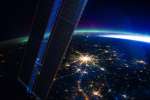 Yuri s Planet
12.04.2012
On another April 12th, in 1961, Soviet cosmonaut Yuri Alexseyevich Gagarin became the first human to see planet Earth from space. Commenting on his view from orbit he reported, "The sky is very dark; the Earth is bluish. Everything is seen very clearly". To celebrate, consider this recent image from the orbiting International Space Station.
|
January February March April May June July August September October |
|||||||||||||||||||||||||||||||||||||||||||||||||