
|
You entered: stars
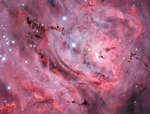 The Deep Lagoon
29.07.2015
Ridges of glowing interstellar gas and dark dust clouds inhabit the turbulent, cosmic depths of the Lagoon Nebula. Also known as M8, The bright star forming region is about 5,000 light-years distant.
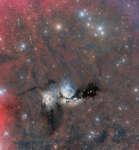 M78 Wide Field
21.01.2021
Interstellar dust clouds and glowing nebulae abound in the fertile constellation of Orion. One of the brightest, M78, is centered in this colorful, wide field view, covering an area north of Orion's belt. At a distance of about 1,500 light-years, the bluish reflection nebula is around 5 light-years across.
 APOD: 2024 December 18 Б NGC 660: Polar Ring Galaxy
18.12.2024
What kind of strange galaxy is this? This rare structure is known as a polar ring galaxy, and it seems to have two different rings of stars. In this galaxy, NGC 660, one ring...
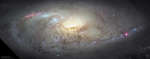 M106 Close Up
3.10.2013
Close to the Great Bear (Ursa Major) and surrounded by the stars of the Hunting Dogs (Canes Venatici), this celestial wonder was discovered in 1781 by the metric French astronomer Pierre Mechain. Later, it was added to the catalog of his friend and colleague Charles Messier as M106.
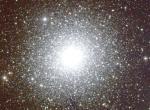 Globular Cluster M2
11.06.2001
Beneath the south pole of our Milky Way Galaxy lies a ball of over 100,000 stars. M2, the second object on Charles Messier's eighteenth century list of bright diffuse sky objects...
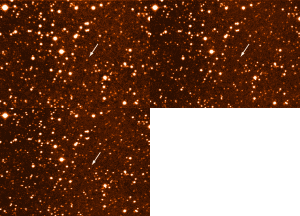 Quaoar: Large Asteroid in the Outer Solar System
9.10.2002
Asteroids almost as large as planets are still being discovered in our own Solar System. Recently an asteroid more than half the size of Pluto was found orbiting at a distance only a little further than the Solar System's most distant planet.
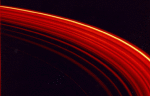 Exploring Saturn's Rings
31.07.1995
By watching a star flicker and fade as it passed behind Saturn's rings, NASA's Voyager 2 spacecraft was able explore the ring system in amazing detail. Data produced by Voyager's instruments...
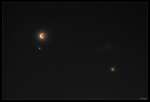 Spica, Mars, and Eclipsed Moon
16.04.2014
A beautiful, reddened Moon slid through dark skies on April 15, completely immersed in Earth's shadow for well over an hour. It was the year's first total lunar eclipse and was widely enjoyed over the planet's Western Hemisphere.
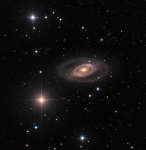 Spiral Galaxy NGC 1350
12.02.2021
This gorgeous island universe lies about 85 million light-years distant in the southern constellation Fornax. Inhabited by young blue star clusters, the tightly wound spiral arms of NGC 1350 seem to join in a circle around the galaxy's large, bright nucleus, giving it the appearance of a cosmic eye.
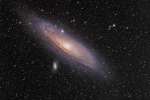 Andromeda Island Universe
9.01.2010
The most distant object easily visible to the eye is M31, the great Andromeda Galaxy some two and a half million light-years away. But without a telescope, even this immense spiral galaxy - spanning over 200,000 light years - appears as a faint, nebulous cloud in the constellation Andromeda.
|
January February March April May June July August September October |
|||||||||||||||||||||||||||||||||||||||||||||||||