
|
You entered: stars
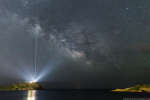 The Milky Way over the Temple of Poseidon
8.06.2015
What's that glowing in the distance? Although it may look like a lighthouse, the rays of light near the horizon actually emanate from the Temple of Poseidon at Cape Sounion, Greece. Some temple lights are even reflected in the Aegean Sea in the foreground.
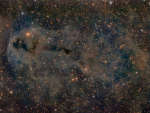 Lynds Dark Nebula 1251
30.09.2016
Stars are forming in Lynds Dark Nebula (LDN) 1251. About 1,000 light-years away, the dusty molecular cloud is part of a complex of dark nebulae mapped toward the Cepheus flare region, drifting above the plane of our Milky Way galaxy.
 Temperatures on Exoplanet WASP 43b
3.05.2024
A mere 280 light-years from Earth, tidally locked, Jupiter-sized exoplanet WASP-43b orbits its parent star once every 0.8 Earth days. That puts it about 2 million kilometers (less than 1/25th the orbital distance of Mercury) from a small, cool sun.
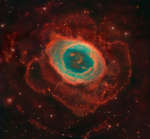 M57: The Ring Nebula
20.04.2012
Except for the rings of Saturn, the Ring Nebula (M57) is probably the most famous celestial band. Its classic appearance is understood to be due to perspective - our view from planet Earth looks down the center of a roughly barrel-shaped cloud of glowing gas.
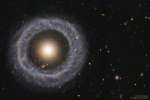 Hoags Object: A Nearly Perfect Ring Galaxy
27.11.2019
Is this one galaxy or two? This question came to light in 1950 when astronomer Arthur Hoag chanced upon this unusual extragalactic object. On the outside is a ring dominated by bright blue stars, while near the center lies a ball of much redder stars that are likely much older.
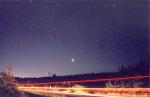 A July Dawn
7.08.2001
Those up before dawn in late July in the northern hemisphere could see planets, stars, and a spacecraft in a single quick glance before starting their day. Near the eastern horizon was bright Jupiter, and not far above and to its right was the very bright Venus.
 The Snake Nebula from CFHT
9.04.2002
What slithers overhead? The dark winding lanes visible in part of the constellation of Ophiuchus belong to the Snake Nebula. Also known as Barnard 72, the Snake Nebula is a series of dark absorption clouds made up of molecular gas and interstellar dust.
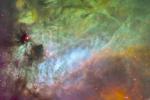 Elements of the Swan Nebula
11.08.2003
In the depths of the dark clouds of dust and molecular gas known as M17, stars continue to form. Also known as the Omega Nebula and Horseshoe Nebula, the darkness of M17's molecular clouds results from background starlight being absorbed by thick filaments of carbon-based smoke-sized dust.
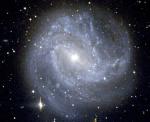 M83: A Barred Spiral Galaxy
25.05.1998
M83 is a bright spiral galaxy that can be found with a small telescope in the constellation of Hydra. M83 is a member of the Centaurus group of galaxies, a nearby group dominated by the massive galaxy Centaurus A. It takes light about 15 million years to reach us from M83.
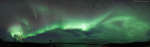 Northern Lights over Prelude Lake
17.09.2010
Curtains of shimmering green light sprawl across this gorgeous night skyscape. In the foreground lies the peaceful Prelude Lake, located about 30 kilometers east of Yellowknife, Northwest Territories, Canada. From high northern latitudes these mesmerizing northern lights, also known as the aurora borealis, are becoming a more familiar sight.
|
January February March April May June July August September October |
|||||||||||||||||||||||||||||||||||||||||||||||||