
|
You entered: sky
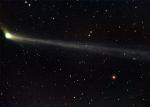 Comet C 2002 T7 (LINEAR)
22.04.2004
Discovered by the the Lincoln Near Earth Asteroid Research (LINEAR) project in October of 2002, comet C/2002 T7 is now visiting the inner solar system, making its closest approach (see animation by L. Koehn) to the Sun tomorrow, April 23rd.
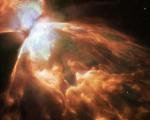 NGC 6302: Big Bright Bug Nebula
5.05.2004
The bright clusters and nebulae of planet Earth's night sky are often named for flowers or insects, and NGC 6302 is no exception. With an estimated surface temperature of about 250,000 degrees...
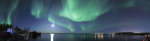 Aurora Over Yellowknife
22.09.2009
Sometimes, after your eyes adapt to the dark, a spectacular sky appears. In this case, a picturesque lake lies in front of you, beautiful green auroras flap high above you, brilliant stars shine far in the distance, and a brilliant moon shines just ahead of you.
 Sunspots and Silhouettes
4.07.2012
What stands between you and the Sun? Apparently, as viewed from Paris last week, one visible thing after another. First, in the foreground, is the Basilica of the Sacred Heart, built in the late 1800s and located on the highest hill in Paris, France.
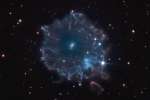 Halo of the Cat s Eye
31.08.2012
The Cat's Eye Nebula (NGC 6543) is one of the best known planetary nebulae in the sky. Its haunting symmetries are seen in the very central region of this tantalizing image, processed to reveal the enormous but extremely faint halo of gaseous material, about 6 light-years across, which surrounds the brighter, familiar planetary nebula.
 Supergiant Star Gamma Cygni
9.07.2013
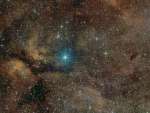
Supergiant star Gamma Cygni lies at the center of the Northern Cross, a famous asterism in the constellation of the Swan (Cygnus). Known by the proper name Sadr, the bright star also lies...
 M2 9: Wings of a Butterfly Nebula
15.09.2013
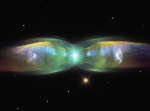
Are stars better appreciated for their art after they die? Actually, stars usually create their most artistic displays as they die. In the case of low-mass stars like our Sun and M2-9 pictured above, the stars transform themselves from normal stars to white dwarfs by casting off their outer gaseous envelopes.
 The Reddening of M71
9.12.2014
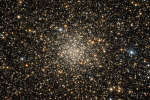
Now known to be a globular star cluster at the tender age of 10 billion years, M71 is a mere 13,000 light-years away within the narrow boundaries of the faint constellation Sagitta. Close...
 Geminids of the South
17.12.2015
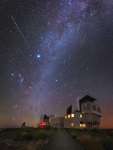
Earth's annual Geminid meteor shower did not disappoint, peaking before dawn on December 14 as our fair planet plowed through dust from active asteroid 3200 Phaethon. Captured in this southern hemisphere nightscape the meteors stream away from the shower's radiant in Gemini.
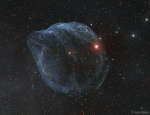 Sharpless 308: Star Bubble
20.12.2016
Blown by fast winds from a hot, massive star, this cosmic bubble is huge. Cataloged as Sharpless 2-308 it lies some 5,200 light-years away toward the constellation of the Big Dog (Canis Major) and covers slightly more of the sky than a full moon.
|
January February March April May June July August September October |
|||||||||||||||||||||||||||||||||||||||||||||||||