
|
You entered: sky
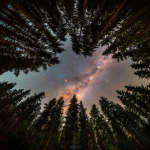 Framed by Trees: A Window to the Galaxy
19.07.2021
The photographer had this shot in mind for some time. He knew that objects overhead are the brightest -- since their light is scattered the least by atmospheric air. He also that knew the core of our Milky Way Galaxy was just about straight up near midnight around this time of year in South Australia.
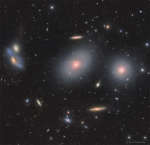 In the Heart of the Virgo Cluster
15.06.2022
The Virgo Cluster of Galaxies is the closest cluster of galaxies to our Milky Way Galaxy. The Virgo Cluster is so close that it spans more than 5 degrees on the sky - about 10 times the angle made by a full Moon.
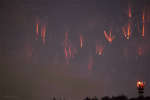 Red Sprite Lightning over the Czech Republic
12.09.2022
What are those red filaments in the sky? They are a rarely seen form of lightning confirmed only about 35 years ago: red sprites. Research has shown that following a powerful positive cloud-to-ground lightning...
 NGC 1893 and the Tadpoles of IC 410
2.02.2024
This cosmic view shows off an otherwise faint emission nebula IC 410, captured under clear Netherlands skies with telescope and narrowband filters. Above and right of center you can spot two remarkable inhabitants of the interstellar pond of gas and dust, known as the tadpoles of IC 410.
 APOD: 2025 March 10 Б NGC 1499: The California Nebula
10.03.2025
Could Queen Calafia's mythical island exist in space? Perhaps not, but by chance the outline of this molecular space cloud echoes the outline of the state of California, USA. Our Sun has its home within the Milky Way's Orion Arm, only about 1,000 light-years from the California Nebula.
 APOD: 2025 July 3 Б Nova V462 Lupi Now Visible
3.07.2025
If you know where to look, you can see a thermonuclear explosion from a white dwarf star. Possibly two. Such explosions are known as novas and the detonations are currently faintly visible with the unaided eye in Earth's southern hemisphere -- but are more easily seen with binoculars.
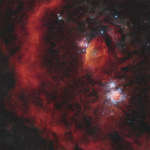 APOD: 2026 February 18 Б Orions Cradle
18.02.2026
Cradled in red-glowing hydrogen gas, stars are being born in Orion. These stellar nurseries lie at the edge of the giant Orion molecular cloud complex, some 1,500 light-years away. This detailed view spans...
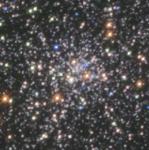 At The Core Of M15
17.01.1998
Densely packed stars in the core of the globular cluster M15 are shown in this Hubble Space Telescope (HST) image. The star colors roughly indicate their temperatures - hot stars appear blue, cooler stars look reddish-orange.
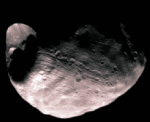 Phobos: Doomed Moon of Mars
2.10.1995
Mars, the red planet named for the Roman god of war, has two tiny moons, Phobos and Deimos, whose names are derived from the Greek for Fear and Panic. These Martian moons may well...
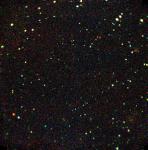 Chandra Deep Field
12.10.2002
Officially the Chandra Deep Field - South, this picture represents the deepest ever x-ray image of the Universe. One million seconds of accumulated exposure time with the orbiting Chandra X-ray Observatory went in to its making.
|
January February March April May June July August September October |
|||||||||||||||||||||||||||||||||||||||||||||||||