
|
You entered: sky
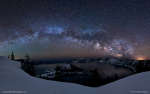 Meteor Over Crater Lake
25.04.2012
Did you see it? One of the more common questions during a meteor shower occurs because the time it takes for a meteor to flash is typically less than the time it takes for a head to turn.
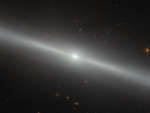 NGC 4762: A Galaxy on the Edge
4.11.2014
Why is there a bright line on the sky? What is pictured above is actually a disk galaxy being seen almost perfectly edge on. The image from the Hubble Space Telescope is a spectacular visual reminder of just how thin disk galaxies can be.
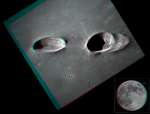 Messier Craters in Stereo
30.05.2015
Many bright nebulae and star clusters in planet Earth's sky are associated with the name of astronomer Charles Messier, from his famous 18th century catalog. His name is also given to these two large and remarkable craters on the Moon.
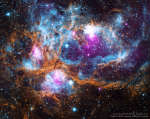 NGC 6357: Stellar Wonderland
26.12.2016
For reasons unknown, NGC 6357 is forming some of the most massive stars ever discovered. This complex wonderland of star formation consists of numerous filaments of dust and gas surrounding huge cavities of massive star clusters. The intricate patterns are caused by complex interactions between interstellar winds, radiation pressures, magnetic fields, and gravity.
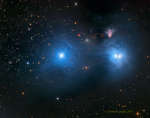 Stars and Dust in Corona Australis
20.09.2018
Cosmic dust clouds and young, energetic stars inhabit this telescopic vista, less than 500 light-years away toward the northern boundary of Corona Australis, the Southern Crown. The dust clouds effectively block light from more distant background stars in the Milky Way.
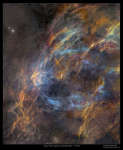 Cygnus Shell Supernova Remnant W63
2.11.2018
The ghost of a long-dead star, the W63 supernova remnant shines like a faint cosmic smoke-ring along the plane of the Milky Way galaxy toward the northern constellation Cygnus the swan. Its wraithlike appearance is traced against the region's rich complex of interstellar clouds and dust by an eerie blue glow.
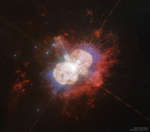 Doomed Star Eta Carinae
20.02.2019
Eta Carinae may be about to explode. But no one knows when - it may be next year, it may be one million years from now. Eta Carinae's mass - about 100 times greater than our Sun - makes it an excellent candidate for a full blown supernova.
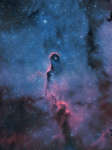 The Elephant's Trunk Nebula in Cepheus
1.08.2020
Like an illustration in a galactic Just So Story, the Elephant's Trunk Nebula winds through the emission nebula and young star cluster complex IC 1396, in the high and far off constellation of Cepheus. Also known as vdB 142, the cosmic elephant's trunk is over 20 light-years long.
 Apollo 11: Armstrong's Lunar Selfie
22.07.2023
A photograph of Buzz Aldrin standing on the Moon taken by Neil Armstrong, was digitally reversed to create this lunar selfie. Captured in July 1969 following the Apollo 11 moon landing, Armstrong's original photograph recorded not only the magnificent desolation of an unfamiliar world, but Armstrong himself reflected in Aldrin's curved visor.
 APOD: 2025 January 28 Б Comet G3 ATLAS over Uruguay
28.01.2025
Comets can be huge. When far from the Sun, a comet's size usually refers to its hard nucleus of ice and rock, which typically spans a few kilometers -- smaller than even a small moon.
|
January February March April May June July August September October |
|||||||||||||||||||||||||||||||||||||||||||||||||