
|
You entered: sky
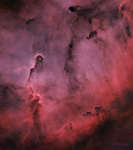 Elephant s Trunk and Caravan
27.08.2021
Like an illustration in a galactic Just So Story, the Elephant's Trunk Nebula winds through the emission nebula and young star cluster complex IC 1396, in the high and far off constellation of Cepheus. Also known as vdB 142, seen on the left the cosmic elephant's trunk is over 20 light-years long.
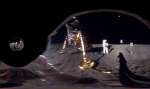 Unwrapped: Five Decade Old Lunar Selfie
27.09.2021
Here is one of the most famous pictures from the Moon -- but digitally reversed. Apollo 11 landed on the moon in 1969 and soon thereafter many pictures were taken, including an iconic picture of Buzz Aldrin taken by Neil Armstrong.
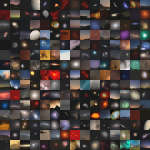 All of These Space Images are Fake Except One
9.11.2021
Why would you want to fake a universe? For one reason -- to better understand our real universe. Many astronomical projects seeking to learn properties of our universe now start with a robotic telescope taking sequential images of the night sky.
 Total Solar Eclipse Below the Bottom of the World
5.12.2021
Yesterday there was a total solar eclipse visible only at the end of the Earth. To capture the unusual phenomenon, airplanes took flight below the clouded seascape of Southern Ocean. The featured image shows...
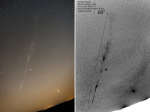 The Further Tail of Comet Leonard
30.12.2021
Comet Leonard, brightest comet of 2021, is at the lower left of these two panels captured on December 29 in dark Atacama desert skies. Heading for its perihelion on January 3 Comet Leonard's visible tail has grown.
 The Tulip and Cygnus X-1
1.09.2022
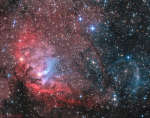
Framing a bright emission region, this telescopic view looks out along the plane of our Milky Way Galaxy toward the nebula rich constellation Cygnus the Swan. Popularly called the Tulip Nebula, the reddish glowing cloud of interstellar gas and dust is also found in the 1959 catalog by astronomer Stewart Sharpless as Sh2-101.
 Shell Galaxies in Pisces
7.11.2024
This spectacular intergalactic skyscape features Arp 227, a curious system of galaxies from the 1966 Atlas of Peculiar Galaxies. Some 100 million light-years distant within the boundaries of the constellation Pisces, Arp 227 consists...
 APOD: 2026 September 27 Б Andromeda before Photoshop
27.09.2026
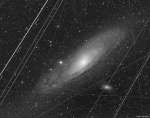
What does the Andromeda galaxy really look like? The featured image shows how our Milky Way Galaxy's closest major galactic neighbor really appears in a long exposure through Earth's busy skies and with a digital camera that introduces normal imperfections.
 Fox Fur, the Unicorn, and a Christmas Tree
28.02.2003
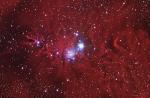
Glowing hydrogen gas fills this gorgeously detailed sky view centered on the variable star S Mon in the faint but fanciful constellation Monoceros, the Unicorn. A star forming region (NGC 2264), the complex jumble...
 The Dark River to Antares
8.07.2009
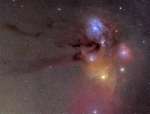
Connecting the Pipe Nebula to the colorful regon near bright star Antares is a dark cloud dubbed the Dark River, flowing from the picture's left edge. Murky looking, the Dark River's appearance is caused by dust obscuring background starlight, although the dark nebula contains mostly hydrogen and molecular gas.
|
January February March April May June July August September October |
|||||||||||||||||||||||||||||||||||||||||||||||||