
|
You entered: sky
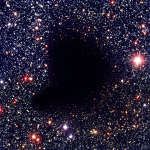 Dark Molecular Cloud Barnard 68
8.10.2017
Where did all the stars go? What used to be considered a hole in the sky is now known to astronomers as a dark molecular cloud. Here, a high concentration of dust and molecular gas absorb practically all the visible light emitted from background stars.
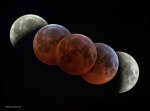 The Umbra of Earth
26.01.2019
The dark, inner shadow of planet Earth is called the umbra. Shaped like a cone extending into space, it has a circular cross section most easily seen during a lunar eclipse. For example...
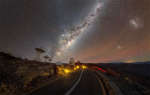 A Road to the Stars
15.03.2022
Pictured -- a very scenic road to the stars. The road approaches La Silla Observatory in Chile, with the ESO's 3.6-meter telescope just up ahead. To the left are some futuristic-looking support structures...
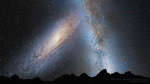 Milky Way Galaxy Doomed: Collision with Andromeda Pending
6.06.2022
Will our Milky Way Galaxy collide one day with its larger neighbor, the Andromeda Galaxy? Most likely, yes. Careful plotting of slight displacements of M31's stars relative to background galaxies on recent Hubble...
 APOD: 2024 April 7 Б A Total Solar Eclipse over Wyoming
7.04.2024
Will the sky be clear enough to see the eclipse? This question is already on the minds of many North Americans hoping to see tomorrow's solar eclipse. This question was also on the mind of many people attempting to see the total solar eclipse that crossed North America in August 2017.
 APOD: 2025 August 28 Б Galaxies, Stars, and Dust
28.08.2025
This well-composed telescopic field of view covers over a Full Moon on the sky toward the high-flying constellation Pegasus. Of course the brighter stars show diffraction spikes, the commonly seen effect of internal supports in reflecting telescopes, and lie well within our own Milky Way galaxy.
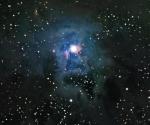 NGC 7023: The Iris Nebula
14.12.2001
Like delicate cosmic petals, these clouds of interstellar dust and gas have blossomed 1,300 light-years away in the fertile star fields of the constellation Cepheus. Sometimes called the Iris Nebula and dutifully cataloged as NGC 7023, this is not the only nebula in the sky to evoke the imagery of flowers.
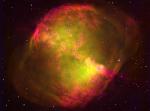 The Dumbbell Nebula in Hydrogen and Oxygen
13.01.2003
The first hint of what will become of our Sun was discovered inadvertently in 1764. At that time, Charles Messier was compiling a list of "annoying" diffuse objects not to be confused with "interesting" comets.
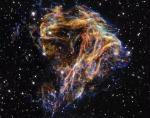 N49 s Cosmic Blast
4.07.2003
Scattered debris from a cosmic supernova explosion lights up the sky in this gorgeous composited image based on data from the Hubble Space Telescope. Cataloged as N49, these glowing filaments of shocked gas span about 30 light-years in our neighboring galaxy, the Large Magellanic Cloud.
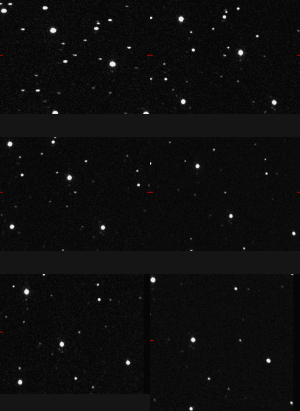 Asteroid 2004 FH Whizzes By
22.03.2004
Last week, a small asteroid approached unusually close to the Earth. Asteroid 2004 FH posed no danger, but became bright enough to see with binoculars. Passing only 7 Earth radii away, this asteroid pass was the closest yet that was previously predicted, although it was discovered only two days before.
|
January February March April May June July August September October |
|||||||||||||||||||||||||||||||||||||||||||||||||