
|
You entered: sky
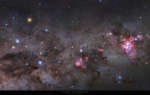 Southern Cross to Eta Carinae
26.04.2019
Tracking along the southern Milky Way this beautiful celestial mosaic was recorded under dark Brazilian skies. Spanning some 20 degrees it actually starts with the dark expanse of the Coalsack nebula at the lower left, tucked under an arm of the Southern Cross.
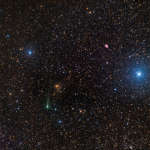 A Comet and a Crab
22.10.2021
This pretty field of view spans over 2 degrees or 4 full moons on the sky, filled with stars toward the constellation Taurus, the Bull. Above and right of center in the frame you can spot the faint fuzzy reddish appearance of Messier 1 (M1), also known as the Crab Nebula.
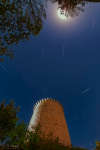 Full Moon Perseids
18.08.2022
The annual Perseid meteor shower was near its peak on August 13. As planet Earth crossed through streams of debris left by periodic Comet Swift-Tuttle meteors rained in northern summer night skies. But even...
 APOD: 2024 November 19 Б Undulatus Clouds over Las Campanas Observatory
19.11.2024
What's happening with these clouds? While it may seem that these long and thin clouds are pointing toward the top of a hill, and that maybe a world-famous observatory is located there, only part of that is true.
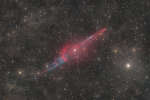 The Bipolar Jets of KX Andromedae
5.12.2025
Blasting outward from variable star KX Andromedae, these stunning bipolar jets are 19 light-years long. Recently discovered, they are revealed in unprecedented detail in this deep telescopic image centered on KX And and composed from over 692 hours of combined image data.
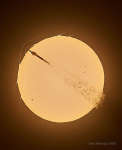 APOD: 2026 June 15 Б Triple Shockwave from Sun Crossing Rocket
15.06.2026
What's happening to this Sun-crossing rocket? The SpaceX Falcon 9 rocket, visible on the upper left, launched only about one minute before this amazing image was captured. As it rose to low Earth...
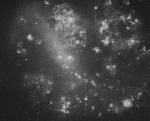 Shell Game in the LMC
18.05.2006
An alluring sight in dark southern skies, the Large Magellanic Cloud (LMC) is seen here through a narrow filter that transmits only the red light of hydrogen atoms. Ionized by energetic starlight, a hydrogen atom emits the characteristic red H-alpha light as its single electron is recaptured and transitions to lower energy states.
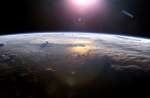 Yuri s Planet
12.04.2008
On April 12th, 1961, Soviet cosmonaut Yuri Alexseyevich Gagarin became the first human in space. His remotely controlled Vostok 1 spacecraft lofted him to an altitude of 200 miles and carried him once around planet Earth. Commenting on the first view from space he reported, "The sky is very dark; the Earth is bluish.
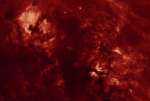 Cygnus Without Stars
24.04.2008
The sky is full of hydrogen, though it can take a sensitive camera and telescope to see it. For example, this twelve-degree-wide view of the northern part of the constellation Cygnus reveals cosmic clouds of hydrogen gas along the plane of our Milky Way galaxy.
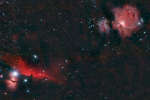 Horsehead and Orion Nebulae
10.03.2009
Adrift 1,500 light-years away in one of the night sky's most recognizable constellations, the glowing Orion Nebula and the dark Horsehead Nebula are contrasting cosmic vistas. They appear in opposite corners of this stunning mosaic taken with a digital camera attached to a small telescope.
|
January February March April May June July August September October |
|||||||||||||||||||||||||||||||||||||||||||||||||