
|
You entered: infrared
 The Once and Future Stars of Andromeda
23.05.2022
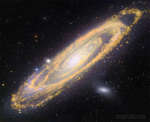
This picture of Andromeda shows not only where stars are now, but where stars will soon be. Of course, the big, beautiful Andromeda Galaxy, M31, is a spiral galaxy -- and a mere 2.5 million light-years away.
 The Once and Future Stars of Andromeda
7.10.2023
This picture of Andromeda shows not only where stars are now, but where stars will be. The big, beautiful Andromeda Galaxy, M31, is a spiral galaxy a mere 2.5 million light-years away. Image data...
 M16: Stars, Pillars and the Eagle s EGGs
3.01.2002
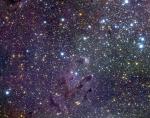
The Hubble Space Telescope's 1995 image of pillars of dust and gas, light-years long, within the Eagle Nebula (M16) was sensational. The three prominent pillars in that close-up visible light picture also appear...
 An Extreme Black Hole Outburst
11.03.2020
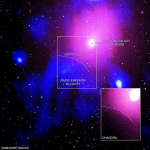
Astronomers believe they have now found the most powerful example of a black hole outburst yet seen in our Universe. The composite, false-color featured image is of a cluster of galaxies in the constellation of Ophiuchus, the serpent-bearer.
 Temperatures on Exoplanet WASP 43b
3.05.2024
A mere 280 light-years from Earth, tidally locked, Jupiter-sized exoplanet WASP-43b orbits its parent star once every 0.8 Earth days. That puts it about 2 million kilometers (less than 1/25th the orbital distance of Mercury) from a small, cool sun.
 Companion of a Young, Sun-like Star Confirmed
4.07.2010
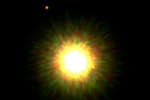
The first direct image of an extrasolar planet orbiting a star similar to our Sun has been confirmed. Located just 500 light-years away toward the constellation Scorpius, the parent star, cataloged as 1RXS J160929.1-210524, is only slightly less massive and a little cooler than the Sun.
 Unexplained Dimmings in KIC 8462852
13.06.2016
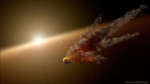
Why does star KIC 8462852 keep wavering? Nobody knows. A star somewhat similar to our Sun, KIC 8462852 was one of many distant stars being monitored by NASA's robotic Kepler satellite to see if it had planets.
 At the Center of the Milk Way
18.10.2002
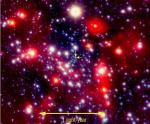
At the center of our Milky Way Galaxy lies a black hole with over 2 million times the mass of the Sun. Once a controversial claim, this astounding conclusion is now virtually inescapable and based on observations of stars orbiting very near the galactic center.
 APOD: 2026 June 29 Б M82: Galaxy with a Supergalactic Wind
29.06.2026
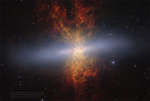
Why is the Cigar Galaxy billowing red smoke? M82, as this starburst galaxy is also known, was stirred up by a recent pass near large spiral galaxy M81. This doesn't fully explain the source of the red-glowing outwardly expanding gas and dust, however.
 Tychos Supernova Remnant
17.03.2009
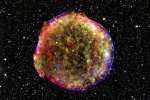
What star created this huge puffball? Pictured above is the best multi-wavelength image yet of Tycho's supernova remnant, the result of a stellar explosion first recorded over 400 years ago by the famous astronomer Tycho Brahe.
|
January February March April May June July August September October |
|||||||||||||||||||||||||||||||||||||||||||||||||