
|
You entered: infrared
 The Dark Seahorse of Cepheus
19.09.2024
Spanning light-years, this suggestive shape known as the Seahorse Nebula floats in silhouette against a rich, luminous background of stars. Seen toward the royal northern constellation of Cepheus, the dusty, dark nebula is part of a Milky Way molecular cloud some 1,200 light-years distant.
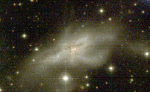 NGC 6240: When Galaxies Collide
28.12.1995
Sometimes even galaxies can suffer a fatal attraction. Here gravity causes two galaxies to collide in a spectacular display of energetic gas, dust, and light. When galaxies collide it is rare that any stars in the galaxies themselves collide, or that any change will be seen in a human lifetime.
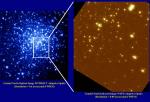 NGC 6934 from Gemini North
30.06.1999
What's going on near the center of globular cluster NGC 6934? The blur caused by the Earth's atmosphere has prevented astronomers from discerning individual stars in this unusual environment. Telescopes in space can help, but the new Gemini North telescope took the above picture from the ground.
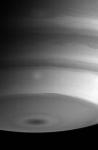 Southern Saturn from Cassini
18.10.2004
What happens to Saturn's pervasive clouds at its South Pole? Visible in the above image of Saturn are bright bands, dark belts and a dark spot right over the South Pole. The above...
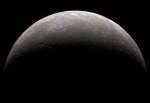 Crescent Mercury in Color
26.01.2008
Hard to spot against the twilight glow near planet Earth's horizon, a crescent Mercury was imaged close up by the MESSENGER spacecraft early last week. Colors in this remarkable picture were created using data recorded through infrared, red, and violet filters.
 Haunting the Cepheus Flare
30.10.2008
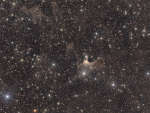
Spooky shapes seem to haunt this starry expanse, drifting through the night in the royal constellation Cepheus. Of course, the shapes are cosmic dust clouds faintly visible in dimly reflected starlight. Far from your...
 Messier 77
10.05.2013
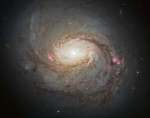
Face-on spiral galaxy M77 lies a mere 47 million light-years away toward the aquatic constellation Cetus. At that estimated distance, the gorgeous island universe is about 100 thousand light-years across. Also known...
 Messier 99
24.06.2021
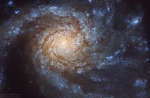
Grand design spiral galaxy Messier 99 looks majestic on a truly cosmic scale. This recently processed full galaxy portrait stretches over 70,000 light-years across M99. The sharp view is a combination of ultraviolet, visible, and infrared image data from the Hubble Space Telescope.
 Planet Earth From TIROS 1: First TV Image
1.04.2000
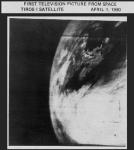
The Television InfraRed Observational Satellite (TIROS) 1 was the first weather satellite. Launched into a polar orbit 40 years ago (April 1, 1960) equipped with two TV cameras, TIROS 1 was operational for only 78 days but demonstrated the feasibility of monitoring planet Earth's cloud cover and weather patterns from space.
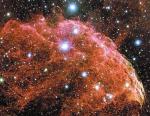 Galactic Supernova Remnant IC 443
3.09.2003
About 8000 years ago, a star in our Galaxy exploded. Ancient humans might have noticed the supernova as a temporary star, but modern humans can see the expanding shell of gas even today. Pictured...
|
January February March April May June July August September October |
|||||||||||||||||||||||||||||||||||||||||||||||||