
|
You entered: infrared
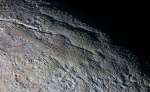 Pluto s Snakeskin Terrain
25.09.2015
A mountainous region informally known as Tartarus Dorsa sprawls some 530 kilometers (330 miles) across this Plutonian landscape. Recently downloaded from New Horizons, it combines blue, red, and infrared image data in an extended color view captured near the spacecraft's close approach to Pluto on July 14.
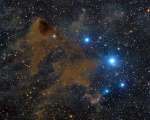 Lynds Dark Nebula 183
21.10.2017
Beverly Lynds Dark Nebula 183 lies a mere 325 light-years away, drifting high above the plane of our Milky Way Galaxy. Obscuring the starlight behind it when viewed at optical wavelengths, the dark, dusty molecular cloud itself seems starless.
 UB313: Larger than Pluto
7.02.2006
What do you call an outer Solar System object that is larger than Pluto? Nobody is yet sure. The question arose recently when 2003 UB313, an object currently twice as far out as Pluto and not in the plane with the rest of the planets, was verified recently to be 30 percent wider than Pluto.
 Saturn from Earth
2.09.1998
Saturn is the second largest planet in our Solar System. Saturn has been easily visible in the sky since history has been recorded. Galileo used one of the first telescopes in 1610 to discover Saturn's rings, which he first thought were moons.
 Light from a Extra Solar Planet
5.04.2005
Light emitted by a planet far beyond our Solar System has been identified for the first time. The planet, illustrated in the above drawing, had its light detected by comparing the brightness of only...
 The Swirling Storms of Saturn
10.10.2005
Storms larger than hurricanes continually dot the upper atmosphere of the planet Saturn. A view of many storms occurring simultaneously was captured in July by the robot Cassini spacecraft now orbiting Saturn. An image of unusually high detail was made possible at that time when Cassini isolated a very specific color of polarized infrared light.
 The Snake Nebula from CFHT
9.04.2002
What slithers overhead? The dark winding lanes visible in part of the constellation of Ophiuchus belong to the Snake Nebula. Also known as Barnard 72, the Snake Nebula is a series of dark absorption clouds made up of molecular gas and interstellar dust.
 Carina Nebula Dust Pillar
7.02.2015
This cosmic pillar of gas and dust is nearly two light-years wide. The structure lies within one of our galaxy's largest star forming regions, the Carina Nebula, shining in southern skies at a distance of about 7,500 light-years.
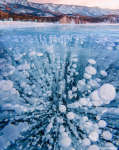 Methane Bubbles Frozen in Lake Baikal
18.12.2018
What are these bubbles frozen into Lake Baikal? Methane. Lake Baikal, a UNESCO World Heritage Site in Russia, is the world's largest (by volume), oldest, and deepest lake, containing over 20% of the world's fresh water.
 The Water Vapor Channel
12.10.1996
What alien planet's bizarre landscape lurks below these fiery-looking clouds? It's only Planet Earth, of course -- as seen on the Water Vapor Channel. Hourly, images like this one (shown in false color) are brought to you by the orbiting GOES 8 satellite's multi-channel imager.
|
January February March April May June July August September October |
|||||||||||||||||||||||||||||||||||||||||||||||||