
|
You entered: infrared
 The Dark Seahorse in Cepheus
5.11.2021
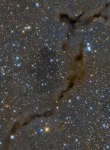
Light-years across, this suggestive shape known as the Seahorse Nebula appears in silhouette against a rich, luminous background of stars. Seen toward the royal northern constellation of Cepheus, the dusty, obscuring clouds are part of a Milky Way molecular cloud some 1,200 light-years distant.
 The Dark Seahorse in Cepheus
20.04.2023
Spanning light-years, this suggestive shape known as the Seahorse Nebula appears in silhouette against a rich, luminous background of stars. Seen toward the royal northern constellation of Cepheus, the dusty, obscuring clouds are part of a Milky Way molecular cloud some 1,200 light-years distant.
 Jupiter: At The Belt-Zone Boundary
10.03.1997
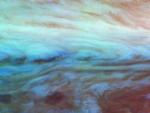
Jupiter's thick atmosphere is striped by wind-driven cloud bands that remain fixed in latitude - dark colored bands are known as belts while light colored bands are zones. At Jupiter's belt-zone boundaries the shearing wind velocities can reach nearly 300 miles per hour.
 The 2MASS Galaxy Sky
26.06.2005
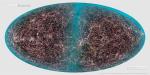
Are the nearest galaxies distributed randomly? A plot of over one million of the brightest "extended sources" detected by the Two Micron All Sky Survey (2MASS) shows that they are not. The vast majority of these infrared extended sources are galaxies.
 One Million Galaxies
27.12.2010
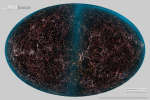
Are the nearest galaxies distributed randomly? A plot of over one million of the brightest "extended sources" detected by the Two Micron All Sky Survey (2MASS) shows that they are not. The vast majority of these infrared extended sources are galaxies.
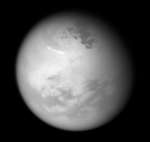 Northern Summer on Titan
22.06.2017
While yesterday's solstice brought summer to planet Earth's northern hemisphere, a northern summer solstice arrived for ringed planet Saturn nearly a month ago on May 24. Following the Saturnian seasons, its large moon Titan was captured in this Cassini spacecraft image from June 9.
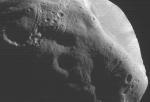 Dust Hip Deep on Phobos
14.09.1998
Landing on the Martian Moon Phobos might be harder than previously thought. The reason: Moon dust. Recent photographs of Phobos have indicated that a layer of fine powder estimated to be a meter deep covers the whole surface. Evidence comes from infrared pictures that indicate the rapid speed that Phobos' surface cools after sunset.
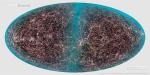 The 2MASS Galaxy Sky
17.09.2003
Are the nearest galaxies distributed randomly? A plot of over one million of the brightest "extended sources" detected by the Two Micron All Sky Survey (2MASS) shows that they are not. The vast majority of these infrared extended sources are galaxies.
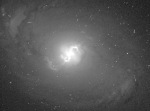 NGC 3393: A Super Spiral?
4.08.1996
A bird? A plane? No, but pictured here is something physically much larger, flying much higher, and moving much faster than either of these. It is, in fact, a Seyfert type 2 spiral galaxy. The "S" is actually a lane of stars, gas and dust circling the core.
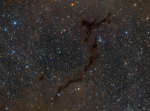 Barnard 150: Seahorse in Cepheus
25.10.2018
Light-years across, this suggestive shape known as the Seahorse Nebula appears in silhouette against a rich, luminous background of stars. Seen toward the royal northern constellation of Cepheus, the dusty, obscuring clouds are part of a Milky Way molecular cloud some 1,200 light-years distant.
|
January February March April May June July August September October |
|||||||||||||||||||||||||||||||||||||||||||||||||