
|
You entered: stars
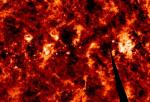 The Frothy Milky Way
24.04.1997
Astronomers have recently discovered that looking at dust along the plane of our Milky Way Galaxy is a bit like looking into a frothy glass of beer. The dust between stars in our galaxy...
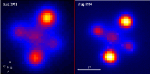 Microlensing of the Einstein Cross
11.07.1995
The famous "Einstein Cross" is a case where a single object is seen four times. Here a very distant QSO happened to be placed right behind a massive galaxy. The gravitational effect...
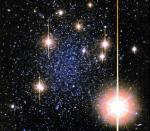 Pegasus dSph: Little Galaxy of the Local Group
21.01.1999
The Pegasus dwarf spheroidal galaxy (Peg dSph) is a small, newly recognized member of the Local Group of Galaxies. Likely a satellite companion of the Local Group's dominant player, the large spiral Andromeda (M31), the Pegasus dwarf galaxy is almost hidden in the glare of relatively bright foreground stars in our own Milkyway.
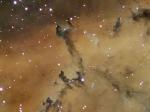 Dust Sculptures in the Rosette Nebula
9.01.2005
What creates the cosmic dust sculptures in the Rosette Nebula? Noted for the common beauty of its overall shape, parts of the Rosette Nebula, also known as NGC 2244, show beauty even when viewed up close.
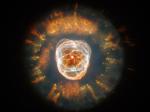 The Eskimo Nebula from Hubble
9.07.2006
In 1787, astronomer William Herschel discovered the Eskimo Nebula. From the ground, NGC 2392 resembles a person's head surrounded by a parka hood. In 2000, the Hubble Space Telescope imaged the Eskimo Nebula. From space, the nebula displays gas clouds so complex they are not fully understood.
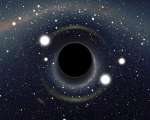 Too Close to a Black Hole
6.12.2010
What would you see if you went right up to a black hole? Above is a computer generated image highlighting how strange things would look. The black hole has such strong gravity that light is noticeably bent towards it - causing some very unusual visual distortions.
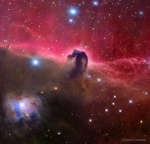 The Magnificent Horsehead Nebula
12.05.2015
Sculpted by stellar winds and radiation, a magnificent interstellar dust cloud by chance has assumed this recognizable shape. Fittingly named the Horsehead Nebula, it is some 1,500 light-years distant, embedded in the vast Orion cloud complex.
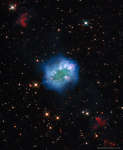 Jets from the Necklace Nebula
17.05.2021
What celestial body wears the Necklace Nebula? First, analyses indicate that the Necklace is a planetary nebula, a gas cloud emitted by a star toward the end of its life. Also, what appears to be diamonds in the Necklace are actually bright knots of glowing gas.
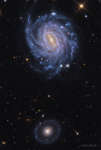 APOD: 2026 May 26 Б NGC 3660 and Burcins Galaxy
25.05.2026
The upper galaxy might be more photogenic, but the lower galaxy is more unusual. The galaxy up top is NGC 3660, a spiral galaxy similar to our own Milky Way galaxy in that it has several bright blue spiral arms and a central bar of stars, dust, and gas.
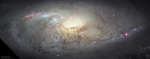 M106 Close Up
3.05.2012
Close to the Great Bear (Ursa Major) and surrounded by the stars of the Hunting Dogs (Canes Venatici), this celestial wonder was discovered in 1781 by the metric French astronomer Pierre Mechain. Later, it was added to the catalog of his friend and colleague Charles Messier as M106.
|
January February March April May June July August September October |
|||||||||||||||||||||||||||||||||||||||||||||||||