
|
You entered: star
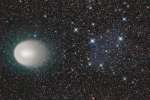 Amazing Comet Holmes
24.10.2008
One year ago, Comet 17P/Holmes amazed sky watchers across planet Earth. A stunningly rapid outburst transformed it from a faint comet quietly orbiting the Sun with a period of about 7 years to a naked-eye comet rivaling the brighter stars in the constellation Perseus.
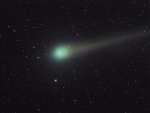 Comet Lulin and Distant Galaxies
7.03.2009
Now fading in our night sky, Comet Lulin has provided some lovely cosmic vistas. Moving rapidly against the background of stars, Lulin briefly posed with the likes of Saturn, and Regulus (Alpha Leo). But here it is seen against a field of distant galaxies.
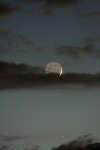 Framed by Clouds
30.04.2009
Last Sunday's fading evening twilight featured a young crescent Moon along the western horizon. The young Moon also shared the sky with the lovely Pleiades star cluster and wandering planet Mercury. Framed by clouds in this serene skyscape from Selsey, UK, a similar twilight scene was visible around the globe.
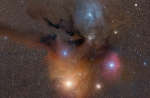 Colorful Clouds Near Rho Ophiuchi
28.08.2012
Why is the sky near Antares and Rho Ophiuchi so colorful? The colors result from a mixture of objects and processes. Fine dust illuminated from the front by starlight produces blue reflection nebulae. Gaseous clouds whose atoms are excited by ultraviolet starlight produce reddish emission nebulae. Backlit dust clouds block starlight and so appear dark.
 Along the Cygnus Wall
11.03.2015
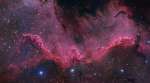
The W-shaped ridge of emission featured in this vivid skyscape is known as the Cygnus Wall. Part of a larger emission nebula with a distinctive outline popularly called The North America Nebula, the cosmic ridge spans about 20 light-years.
 Worlds of a Distant Sun: 47 Ursae Majoris b
5.10.1997
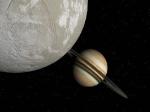
In the last few years, observational astronomy has given humanity evidence of the existence of worlds beyond the solar system. Solar-type stars are now inferred to harbor planets of approximately Jupiter mass - some residing in temperature zones which could conceivably support liquid water and therefore life!
 Keplers Supernova Remnant in X Rays
16.01.2007
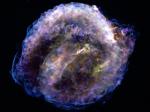
What caused this mess? Some type of star exploded to create the unusually shaped nebula known as Kepler's supernova remnant, but which type? Light from the stellar explosion that created this energized cosmic cloud was first seen on planet Earth in October 1604, a mere four hundred years ago.
 Active Galaxy Centaurus A
10.01.2008
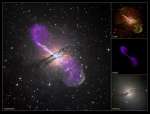
A mere 11 million light-years away, Centaurus A is a giant elliptical galaxy - the closest active galaxy to Earth. This remarkable composite view of the galaxy combines image data from the x-ray ( Chandra), optical(ESO), and radio(VLA) regimes.
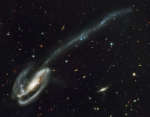 Arp 188 and the Tadpoles Tidal Tail
26.09.2010
Why does this galaxy have such a long tail? In this stunning vista recorded with the Hubble Space Telescope's Advanced Camera for Surveys, distant galaxies form a dramatic backdrop for disrupted spiral galaxy Arp 188, the Tadpole Galaxy. The cosmic tadpole is a mere 420 million light-years distant toward the northern constellation Draco.
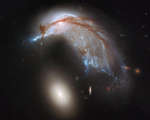 The Porpoise Galaxy from Hubble
24.06.2013
What's happening to this spiral galaxy? Just a few hundred million years ago, NGC 2936, the upper of the two large galaxies shown, was likely a normal spiral galaxy -- spinning, creating stars -- and minding its own business.
|
January February March April May June July August September October |
|||||||||||||||||||||||||||||||||||||||||||||||||